
Pericyclic Reactions: Sigmatropic Rearrangements
Introduction
Pericyclic reactions are characterized by a cyclic transition state in which there is a cyclic arrangement of orbitals and the reorganization of σ and π bonds occurs within this cyclic system. In my discussion of cycloadditions, I avoided talking about orbitals and I intend to continue in this vein as I move onto sigmatropic rearrangements. What you need to know is that the bond formation and breaking takes place in a concerted or simultaneous fashion. This means pericyclic reactions proceed without the formation of intermediates.
There are four main classes of pericyclic reaction; cycloadditions, sigmatropic rearrangements, electrocyclic reactions and group transfer reactions. So far I have only looked cycloadditions as exemplified by the Diels-Alder reaction:
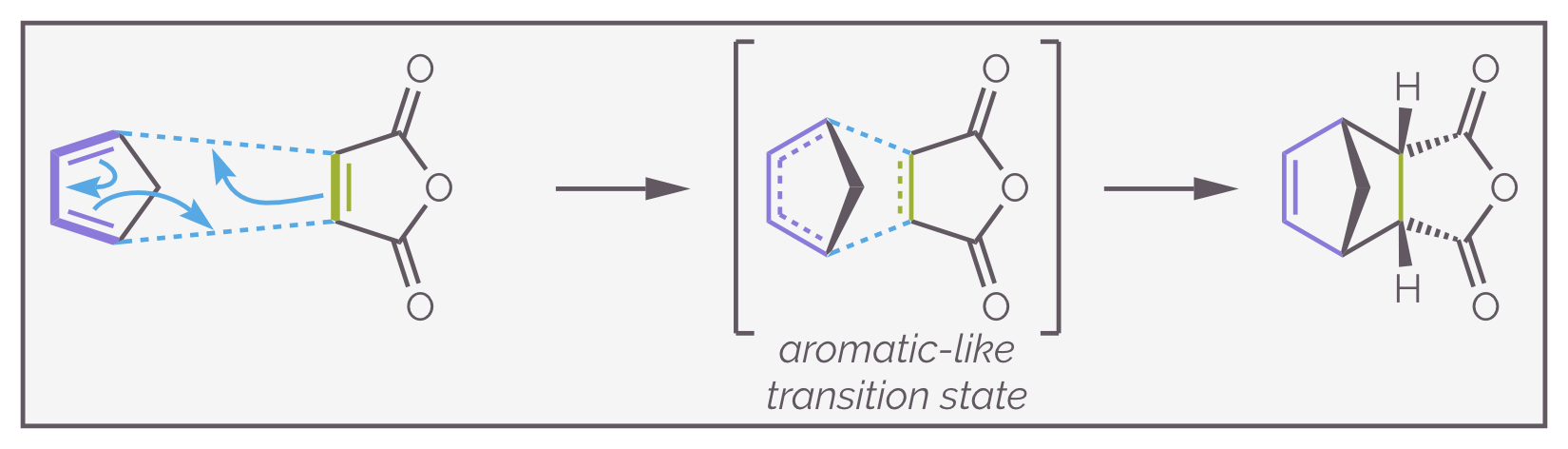
An example of a Diels-Alder reaction, one of the archetypal pericyclic reactions, characterized as they are by the cyclic transition state and the reorganization of σ bonds and π bonds.
At undergraduate, sigmatropic rearrangements are the second most common example of pericyclic reactions, after cycloadditions. Sigmatropic rearrangements involve the change (sometimes described as the movement, but this is a phrase that has misleading implications in my opinion) of a σ (sigma) bond to a new σ (sigma) bond in a single molecule. The transformation is caused by the movement of π (pi) electrons through a cyclic transition state.
There are many types of sigmatropic rearrangement, and they are classed as [m,n]-sigmatropic rearrangements where the m and n refer to the number of atoms involved on each fragment of the molecule implicated (involved?) in σ bond formation or breaking. The numbers effectively tell you how many atoms are between the bond being broken and the bond being formed. There are two numbers as there are two ends to each bond. This is probably easier seen in a diagram:
![Sigmatropic rearrangements are classified as [m,n]-sigmatropic rearrangements where the m and n refer to the number of atoms between the bond being broken and the bond being formed on each fragment of the molecule.](https://images.squarespace-cdn.com/content/v1/62185f3b81809a6fd03ddbb5/94caa850-8d32-4fea-be5d-5cf7896399e2/02_Naming_Rearrangements1.png)
Sigmatropic rearrangements are classified as [m,n]-sigmatropic rearrangements where the m and n refer to the number of atoms between the bond being broken and the bond being formed on each fragment of the molecule.
Another way of drawing this and thus determining the classification of the rearrangement is to identify both the bond being broken and the bond being formed. Next draw a line dividing the two bonds. Count the number of atoms involved in the rearrangement on each fragment. The number on one fragment is m and the number on the second is n:
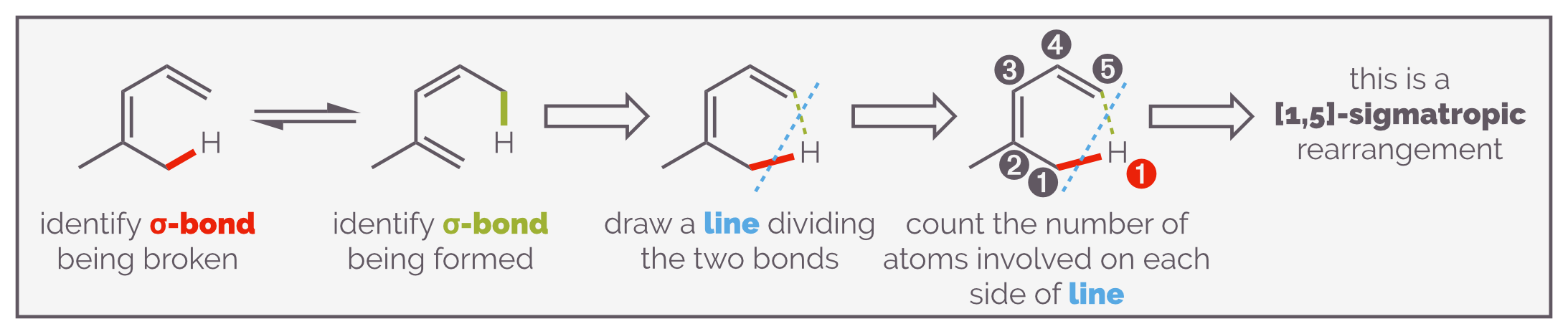
Another method to determine the classification of sigmatropic rearrangements involves identifying the σ bonds being made and broken, drawing a dividing line through these bonds to split the molecule into two fragments then counting the atoms involved in the reaction on each fragment.
In this summary, I’m only going to cover the most common [3,3]-sigmatropic rearrangements, and archetypal variants of these rearrangements can be found in the following transformation:
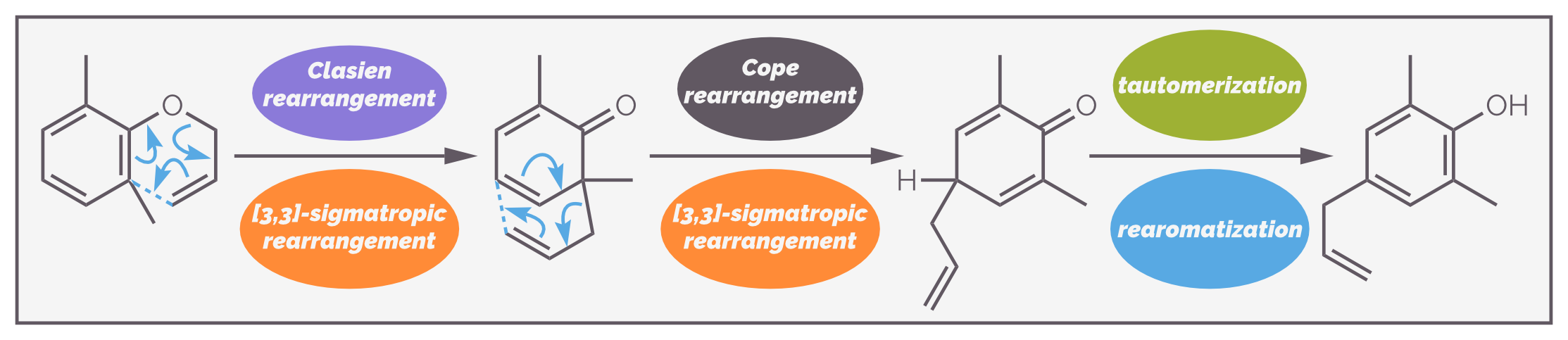
Examples of two [3,3]-sigmatropic rearrangements of an allyl phenyl ether. The first is a Claisen rearrangement and leads to the breaking of aromaticity, which reveals how powerful these reactions can be. The second is a Cope rearrangement. Finally, there is a tautomerization or isomerization to allow aromaticity to be re-established. This is a powerful driving force for reactions.
This example shows both the Claisen and the Cope rearrangements, these, and their variants, will be the focus of this summary. The fact that they can break the aromaticity of a benzene ring shows that these reactions are powerful routes to C-C bond formation. As with the summaries of the cycloadditions, I am only interested in introducing the reactions and their curly arrow mechanism. I will be avoiding discussion of the orbitals involved and the Woodward-Hoffmann rules. These might be the subject of a subsequent summary (but no promises). Effectively, this is an introduction for early undergraduate years.
The Cope Rearrangement
The Cope rearrangement involves the thermal [3,3]-rearrangement of 1,5-dienes. A simple example is shown below. This reaction requires heating > 150 °C.
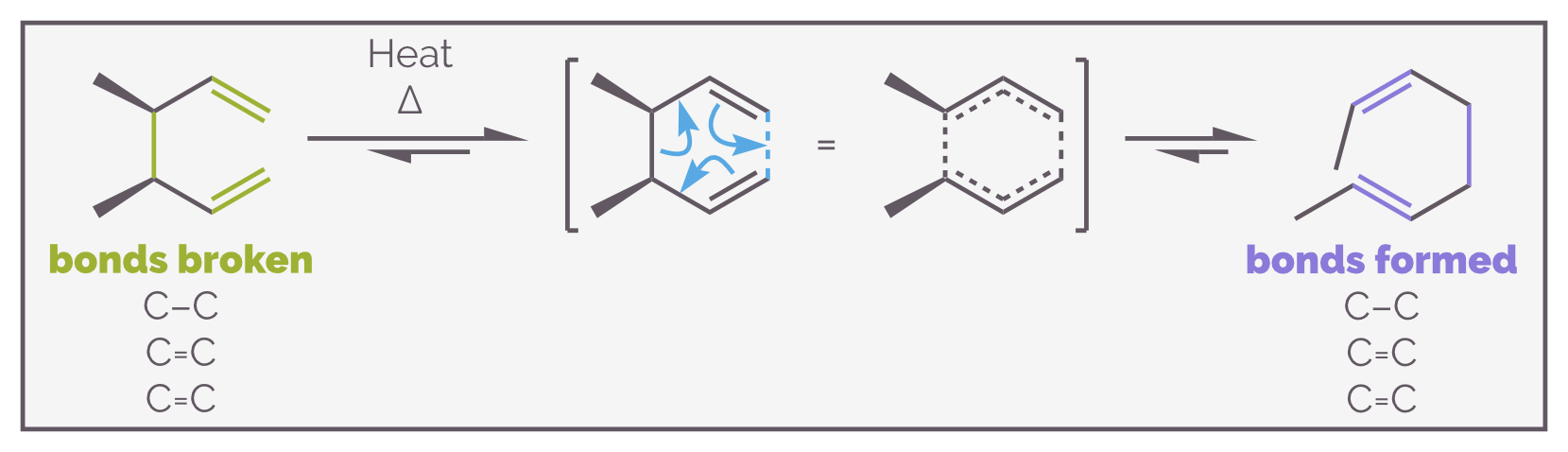
An example of the Cope rearrangement, a [3,3]-sigmatropic rearrangement. The reaction is a high temperature of 1,5-dienes and involves the movement of six electrons. The rearrangement proceeds through a cyclic transition state and, as you shall see, this leads to the transfer for stereochemical information. One σ bond and two C=C π bonds are broken but the same number and type of bonds are formed. This means the reaction is reversible, with little driving forcing pushing it in either direction.
The reaction proceeds through a concerted mechanism, meaning that all the bonds are made and broken at the same time. This means stereochemical information is transferred in a predictable manner as shown for the two diastereomers of the 3,4-dimethylhexa-1,5-diene:
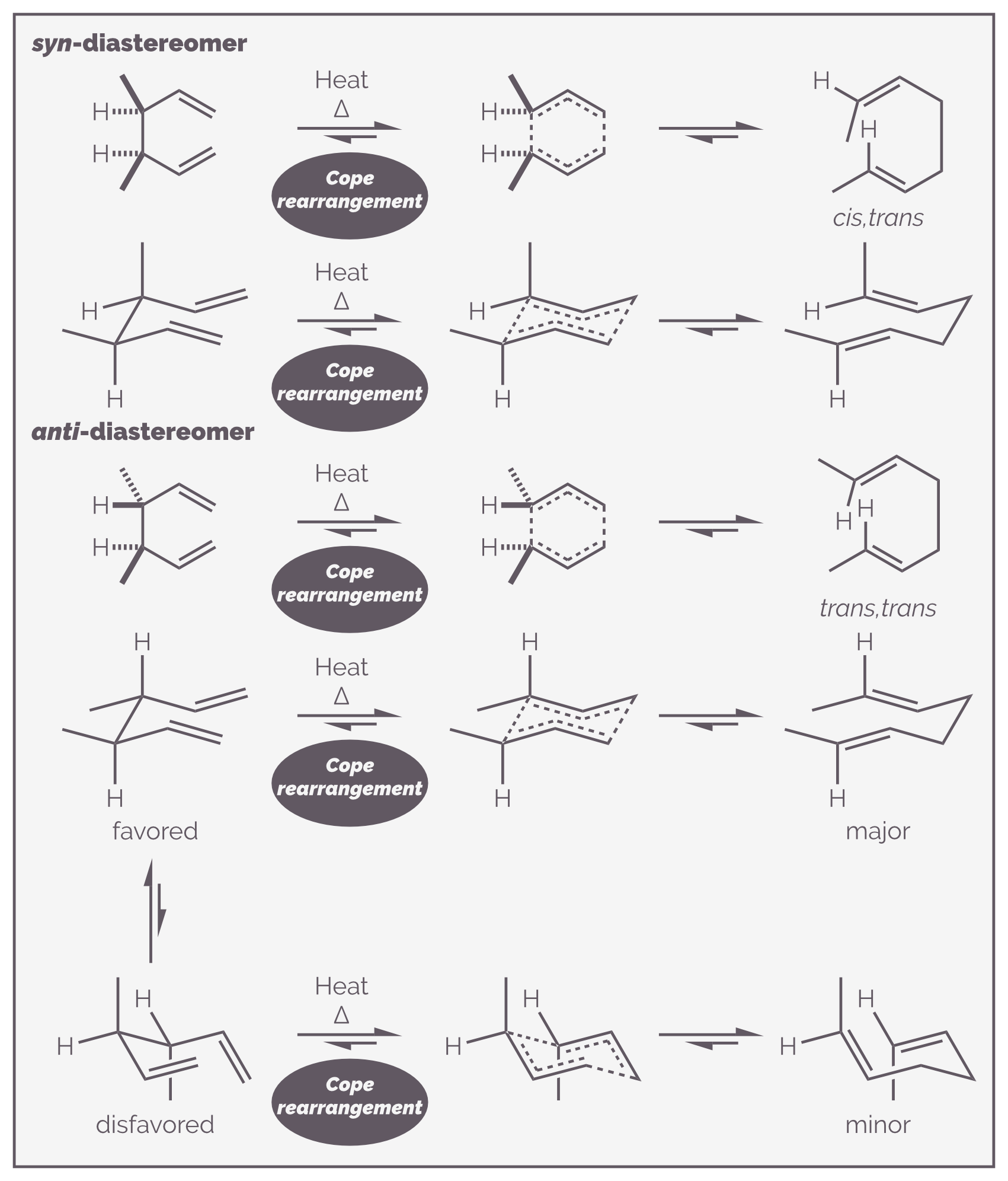
Each diastereoisomer favors a different geometric diene product. The syn-isomer gives the cis,trans-isomer. This is shown first in the normal skeletal representation and then as the chair-like conformation that gives a clearer indication of the stereochemistry. Rearrangement of the anti-diastereomer could proceed through two different conformations but the one with the two methyl groups in equatorial position is favored and this leads to the major, trans,trans product.
The stereochemical outcome is explained by the Woodward-Hoffmann rules or, more simply, by looking at the conformation of the transition state and assuming that the reaction will proceed through the most stable chair-like conformation. For the syn-diastereoisomer above, the two different chair-like conformations are the same. In both there is one methyl group equatorial and another axial. In the second example, there are two possible conformations of the anti-diastereoisomer. In one both methyl groups are axial and in the other both are equatorial. The latter is favoured (see HERE). Using the chair conformation gives the correct stereochemistry for the thermal rearrangement.
The Cope rearrangement is a reversible transformation. The starting material is a 1,5-diene and the product is a 1,5-diene. Good yields of the desired product are only obtained if one product is thermodynamically more favored than the other. In the example above, Zaitsev's rule explains why the righthand side is favored as more substituted alkenes are more stable than less substituted alkenes. In the starting material there are two mono-substituted alkenes. In the product, there are two disubstituted alkenes. Each C–C coming off the alkene adds approximately 4.2-4.4 kJ mol-1 stability due to hyperconjugation.
Another method to drive the reaction forward is to cause one, or more, of the alkenes to move into conjugation with an appropriate electron donor or acceptor. This allows the electrons to be delocalized and increases the stability of the product. The original example of the Cope rearrangement, discovered by Elizabeth Hardy and Arthur Cope, uses this strategy to make the reaction essentially irreversible:

The original version of the Cope rearrangement as developed by Elizabeth Hardy and Arthur Cope. The reaction is driven to the righthand side due to the alkene moving into conjugation with two electron withdrawing groups.
Another strategy to make the rearrangement irreversible is through the release of ring strain. By fragmenting a small ring the reaction cannot return to starting material as this would involve a large increase in the internal energy. Moving to the right is downhill all the way, and is so favored that the rearrangement will occur at room temperature or below. This example may look odd at first but it is exactly the same reaction as all the examples above.

The release of ring strain by opening the cyclopropane forces the reaction to proceed to the righthand side, otherwise, this example is identical to all the others you have just covered.
This has been exploited in total synthesis where the cyclopropane rearrangement precursor is readily formed through a rhodium-carbenoid (J. Org. Chem. 1998, 63, 657). This allows two simple starting materials to be converted into a complex, bicyclic system.
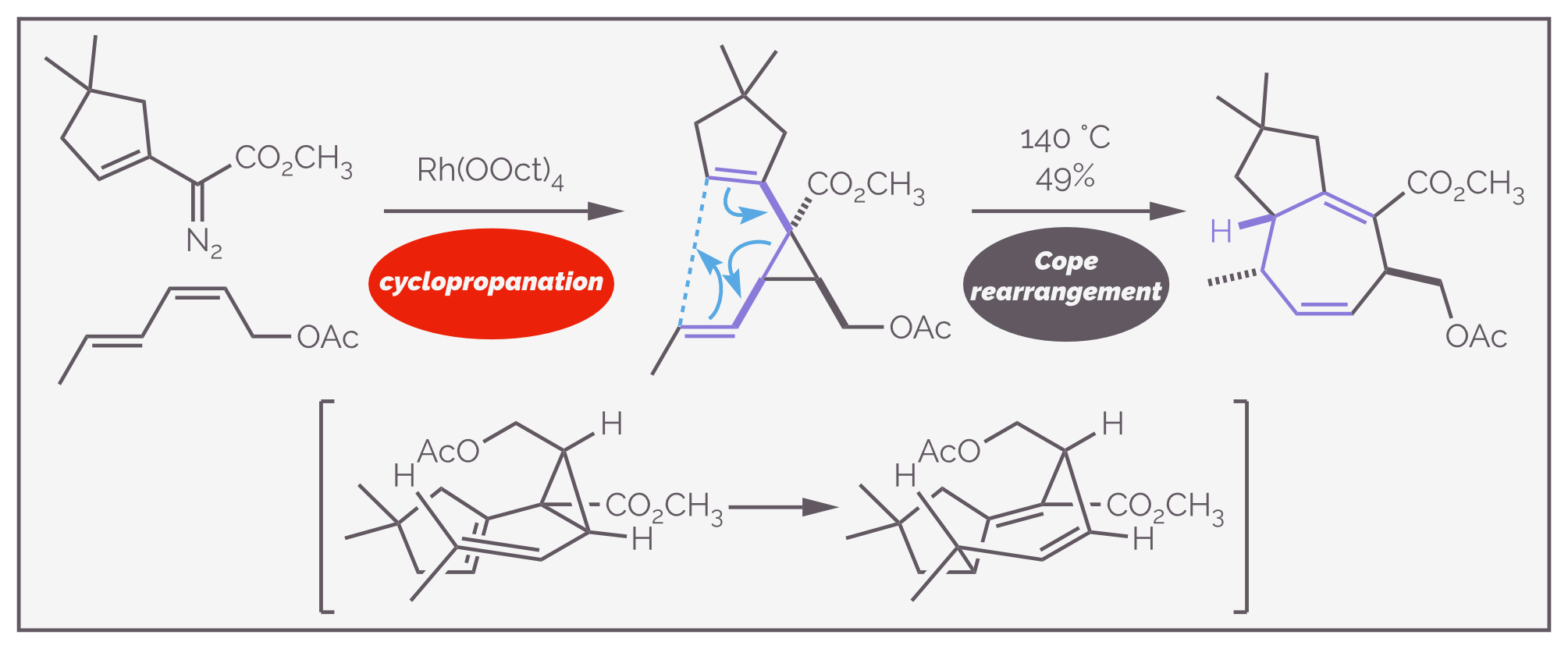
The Cope rearrangement with release of ring strain has been used in the total synthesis of numerous natural products. Simple starting materials are readily converted into strained cyclopropanes through a reactive carbenoid intermediate. The rearrangement then delivers a fused bicyclic system with control of the relative stereochemistry.
One of the most fun examples of ring-strain accelerated Cope rearrangement is found in the molecule bullvalene. This weird molecule has no fixed structure as it fluctuates between 1209600 degenerate (energetically equivalent) isomers (I hope this is the correct word but perhaps tautomers is better?) through a series of rapid Cope rearrangements. Just three are shown below. In the example below, with no substituent, you can't see all of structures as they are equivalent and there is only a single hydrogen or carbon environment by NMR, but if you add a substituent they would separate out. Of course, adding a substituent leads to some being more favorable and the number observed diminishes.
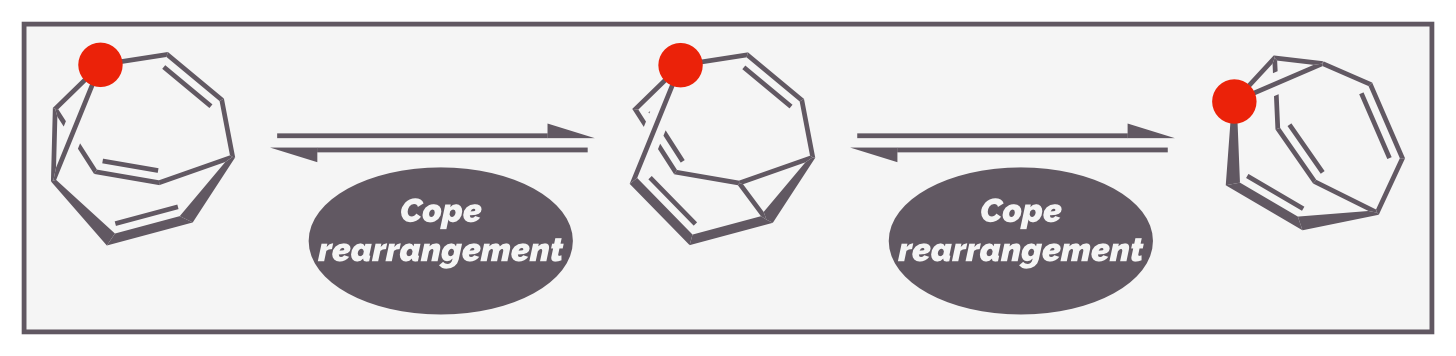
Three isomers (or possibly tautomers) of bullvalene, a molecule that is considered fluxional as it constantly changes structure through a series of Cope rearrangements.
By far the most common method to push the Cope rearrange towards a single product is the oxy-Cope rearrangement. The addition of an alcohol group to the starting 1,5-diene leads to an enol on rearrangement. Delocalization of the oxygen lone pair into the double bond means the product, or righthand side of the reaction, is more favorable. Enols are in equilibrium with the carbonyl form and tautomerization gives an aldehyde. The aldehyde C=O bond is stronger than an alkene and there is no longer the 1,5-diene motif. Both effects influence the direction of the reaction making it essentially irreversible.
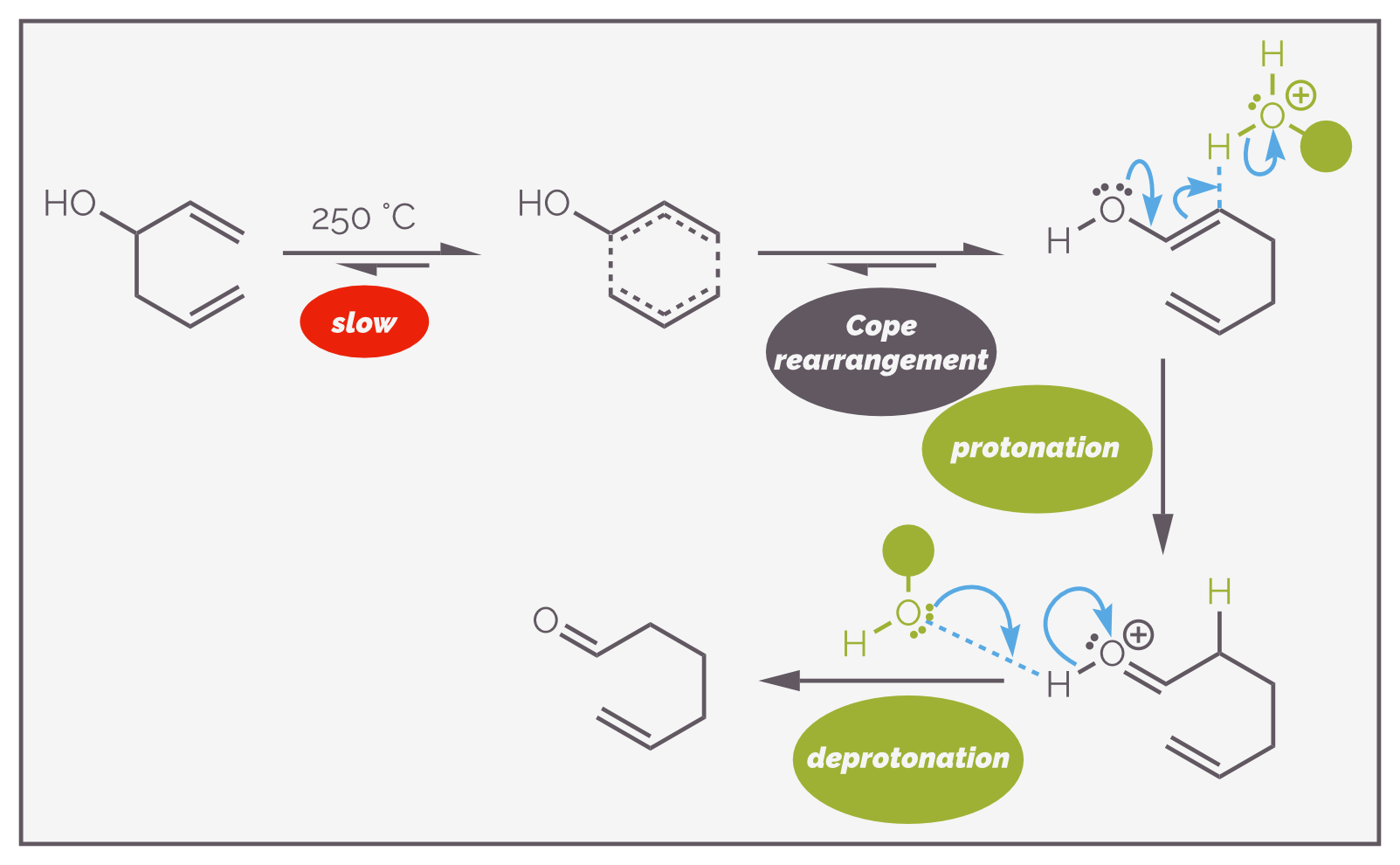
The oxy-Cope rearrangement is essentially an irreversible variant of the Cope rearrangement. The initial rearrangement leads to an enol that tautomerizes to the more stable aldehyde. This also removes the 1,5-diene motif, preventing the reverse rearrangement from occurring.
The oxy-Cope Rearrangement
At first glance, the example above may not seem that special. Yes, the reaction is now essentially irreversible due to keto-enol tautomerization, but it still requires heating to > 250 °C, conditions that are not conducive to the survival of your molecule. What has made the oxy-Cope rearrangement so valuable was the discovery that deprotonation, to give an alkoxy anion rearrangement precursor, allowed the reaction to proceed at room temperature or below. The anionic oxy-Cope rearrangement makes the Cope rearrangement a powerful tool in the synthetic chemists arsenal as the precursors are easy to form and the reaction/rearrangement now occurs under mild conditions.
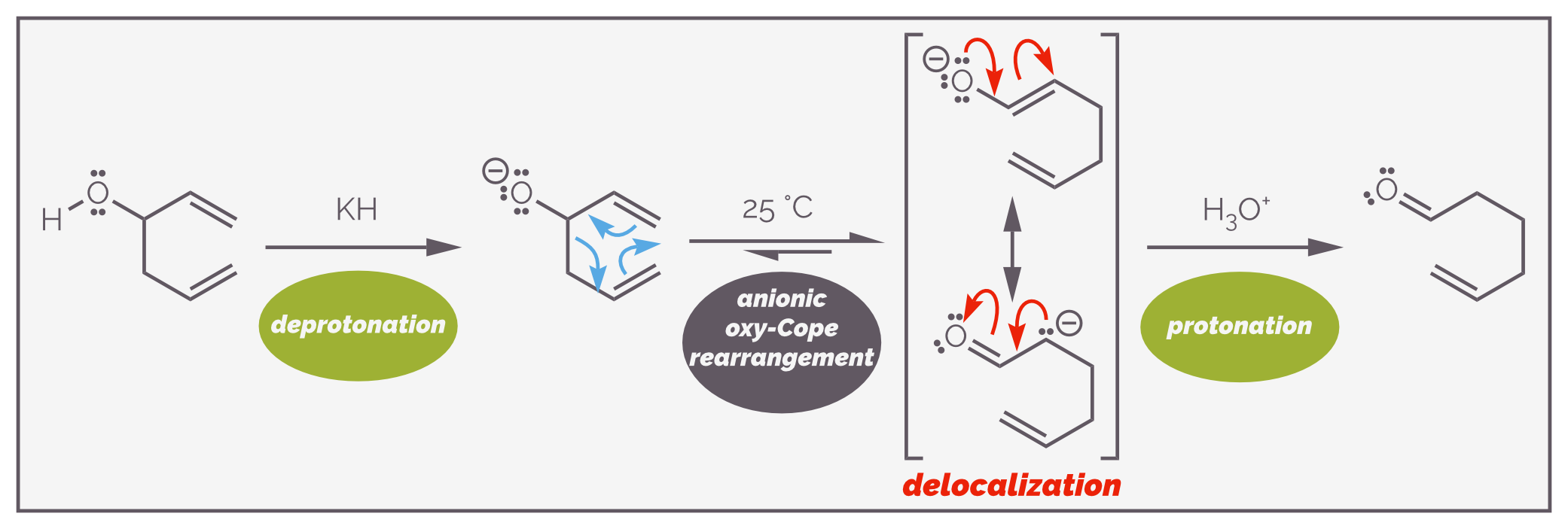
The anionic oxy-Cope rearrangement is a user-friendly version of the Cope rearrangement. Simply deprotonating the alcohol of an oxy-Cope precursor allows the rearrangement to proceed rapidly at low temperature. The mild reaction conditions allow the reaction to occur with complex molecules.
The driving force for the anionic oxy-Cope rearrangement is the delocalization of charge and this can accelerate the reaction 1010 to 1017 times faster than a normal Cope rearrangement. The mechanism has not changed, only the driving force. An example from a natural product synthesis is given below:
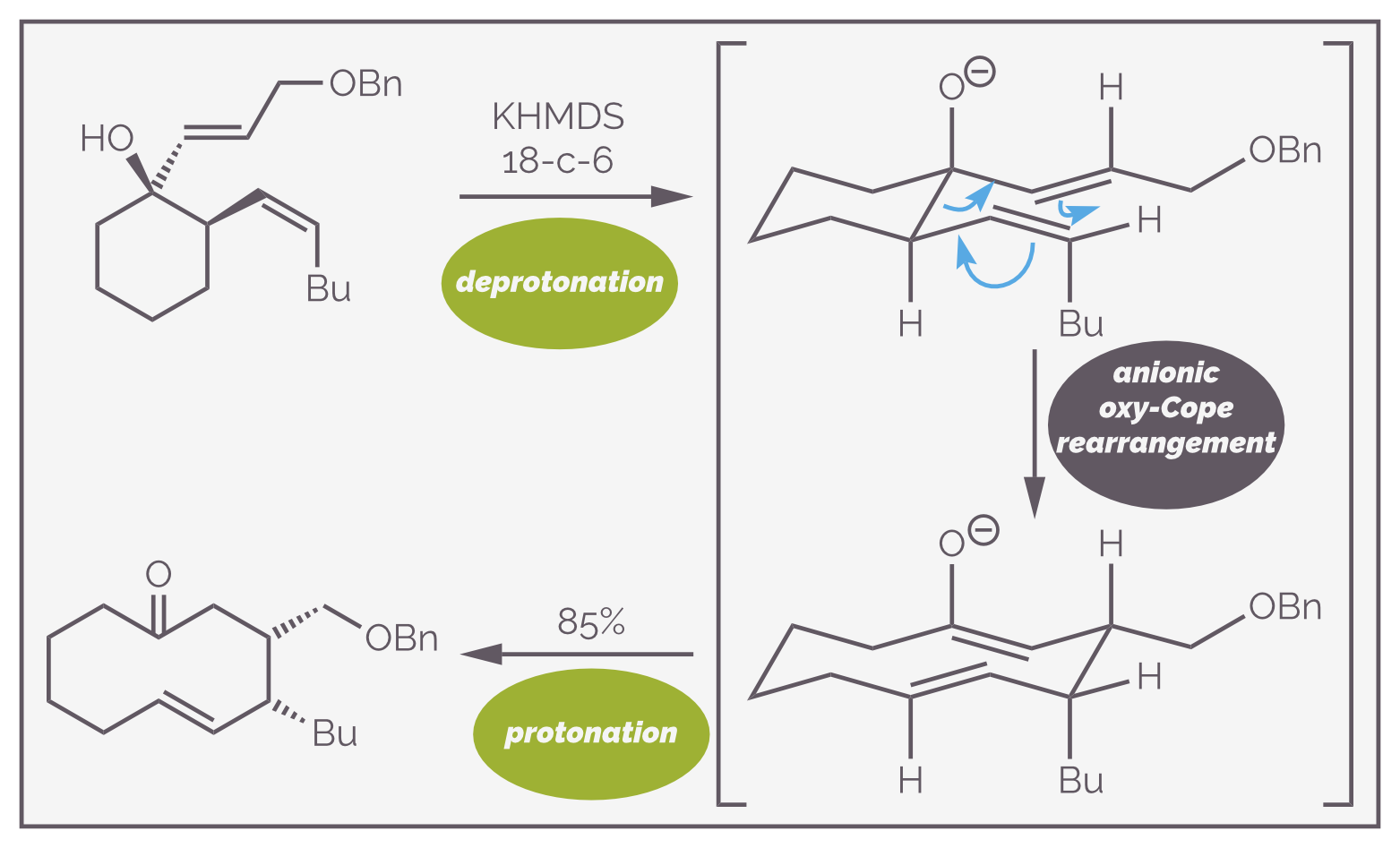
An example of the anionic oxy-Cope rearrangement taken from the synthesis of streptorubin B. The reaction smoothly proceeds with predictable stereochemistry to give the ten-membered ring, a ring that is challenging to make by other processes.
The example above comes from the synthesis of streptorubin B (JACS 2011, 1799). The rearrangement proceeds through a chair-like transition state and this controls the relative stereochemistry of the two substituents, ensuring that the desired cis-configuration is formed.
The Claisen Rearrangement
An early example of a sigmatropic rearrangement is shown below. Here an aryl allyl ether was heated to give the ortho-allyl phenol. The rearrangement occurs by the same mechanism as the Cope rearrangement. There are three curly arrows depicting the movement of six electrons. Remarkably, the reaction proceeds even though it leads to disruption of the aromatic ring. Initially, a ketone is formed that rapidly undergoes tautomerization to regenerate aromaticity.
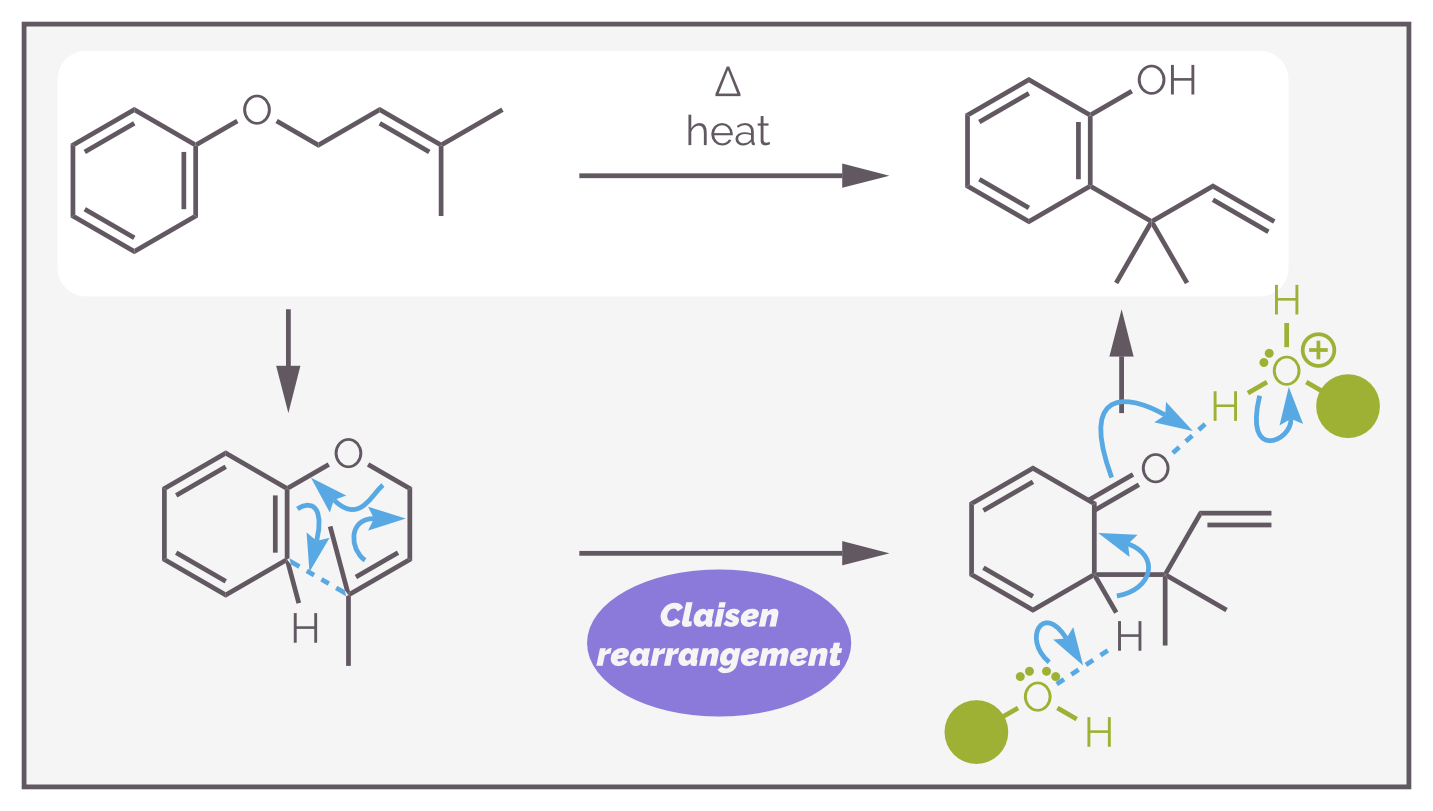
An example of the Claisen rearrangement. The reaction proceeds with breaking of the aromaticity, demonstrating how powerful these rearrangements can be. The ketone rapidly undergoes tautomerization to reform the aromatic ring.
The driving force for the Claisen rearrangement is the sacrifice of a relatively weak C=C π bond for a new carbonyl C=O π bond. Carbonyl bonds are stronger than alkenes and the molecule gains about 80 kJ mol-1 of stability. This additional stability allows the reaction to proceed efficiently and is sufficient to break the aromaticity.
The rearrangement occurs equally well with aliphatic or non-aromatic molecules. The original Claisen rearrangement from 1912 is shown below. I have listed bond strengths so that you can see the gain in stability achieved by the rearrangement.
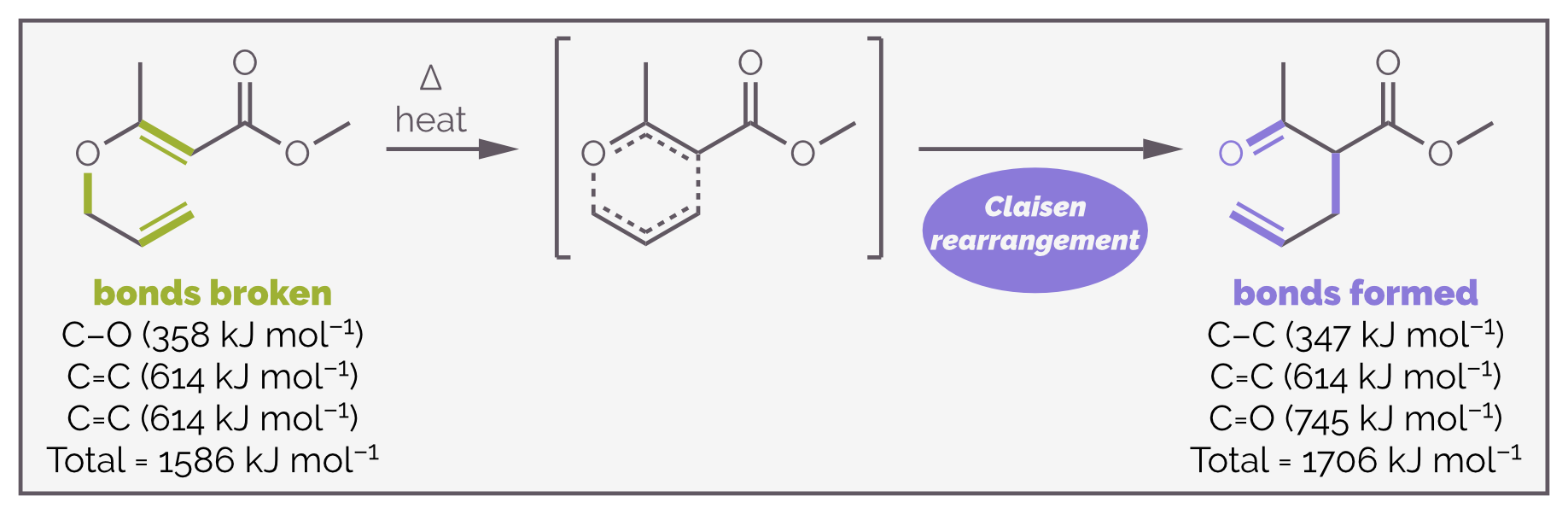
The original Claisen rearrangement and approximate values for the bond dissociation energies. The formation of the C=O bond imparts considerable stability in the product and is the driving force for the reaction.
The Claisen rearrangement is a valuable transformation as the rearrangement precursor is easy to make, it is an enol ether. The rearrangement reliably leads to the formation of a new C–C bond with the excellent transfer of stereochemical information that you have come to expect from pericyclic reactions.
With all the advantages such rearrangements display it is no surprise that they have been used in industrial settings. A combination of the Claisen and Cope rearrangements has been used in the synthesis of citral, an intermediate in the synthesis of vitamin A. First, an aldehyde and alcohol are condensed to form the enol ether rearrangement precursor. Heating the molecule leads to a Claisen rearrangement that forms the precursor to the Cope rearrangement.
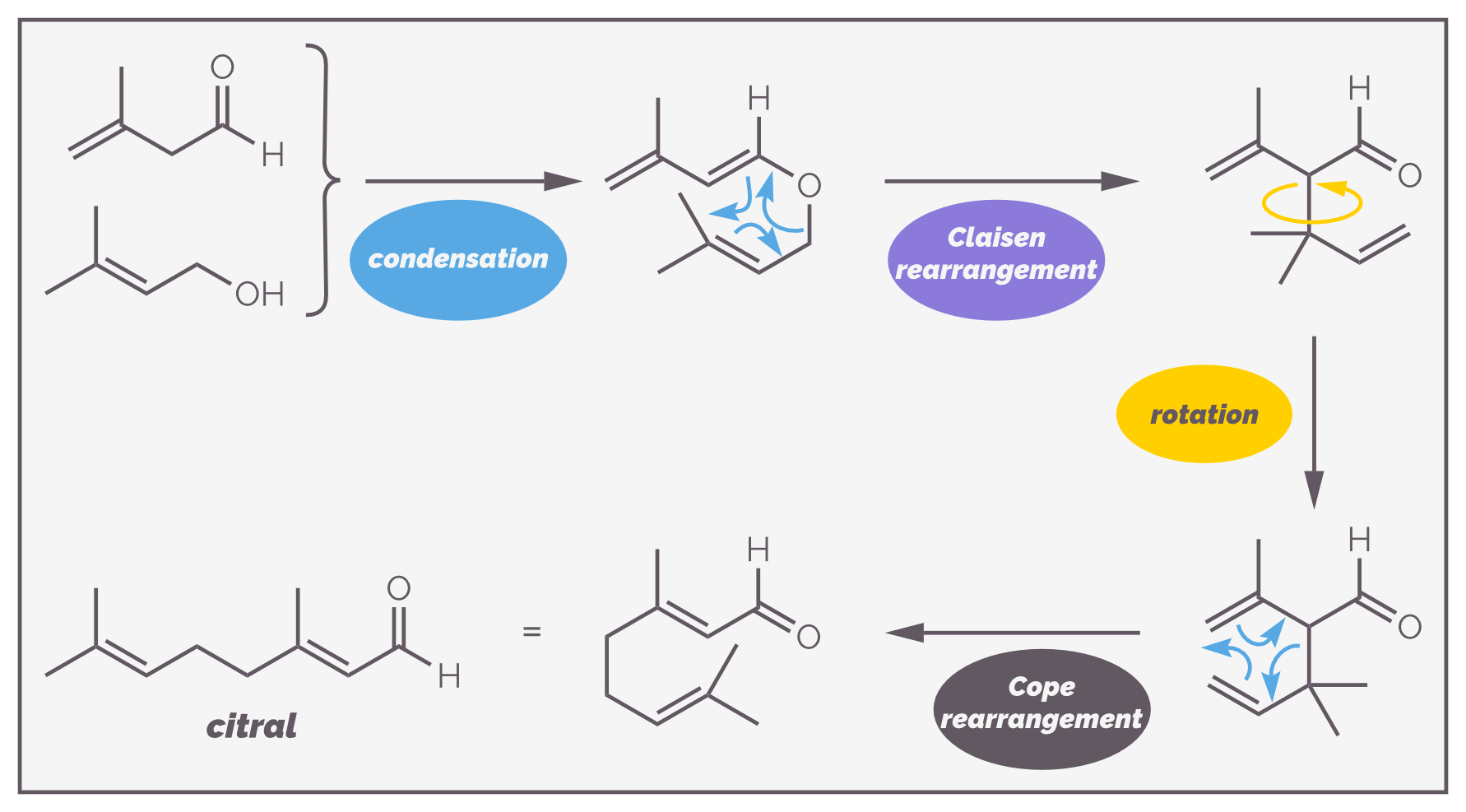
An industrial synthesis of citral involves the condensation of an aldehyde and an alcohol to give an enol ether. Heating this results in a Claisen rearrangement. Rotation of the C–C bond marked with a yellow arrow sets up the second rearrangement, a Cope rearrangement that then furnishes the product.
In the cartoon below, I have tried to summarize the value of the Claisen rearrangement to organic chemists. The rearrangement precursor is readily formed through a variety of ether forming reactions, including alkylation, acylation or ketene acetal formation. The rearrangement is reliable and gives a new C–C bond under relatively mild conditions.
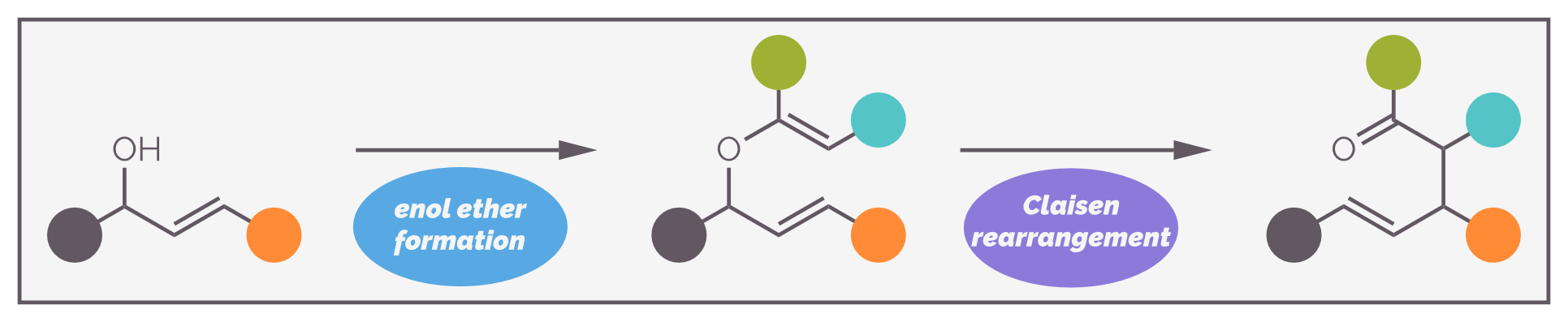
The power of the Claisen rearrangement derives from the ease of synthesizing the precursor before the rearrangement reliably forms a C–C bond with predictable substitution patterns.
The pericyclic nature of the reaction means the geometry of the double bond is transferred to the stereochemistry of the product. A good assumption is that the reaction will proceed through a chair-like transition state:
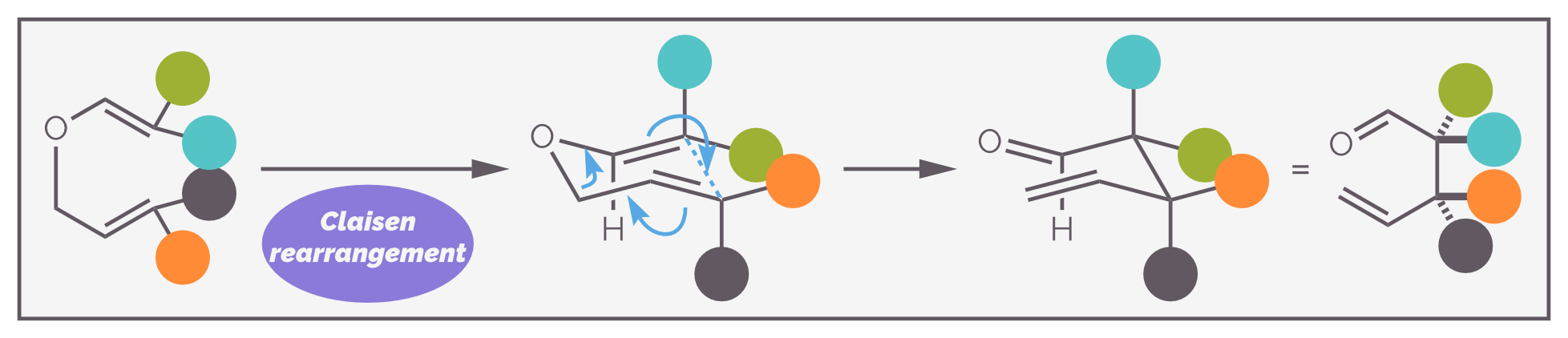
The stereochemistry of the Claisen rearrangement is predictable with the reaction being stereoselective (as you will see, it isn’t stereospecific as there is the opportunity for the reaction to occur through a boat-like transition state). It is more common for the rearrangement to proceed via a chair-like transition state and a simple drawing enables the geometry of the alkene to be translated to the new stereocenters.
A word of warning is that steric effects can force the Claisen rearrangement to progress through a boat-like transition state and this will alter the stereochemical outcome. The good news is that the reaction normally proceeds through one or the other and not both transition states and mixtures of products are rare (in my limited experience).
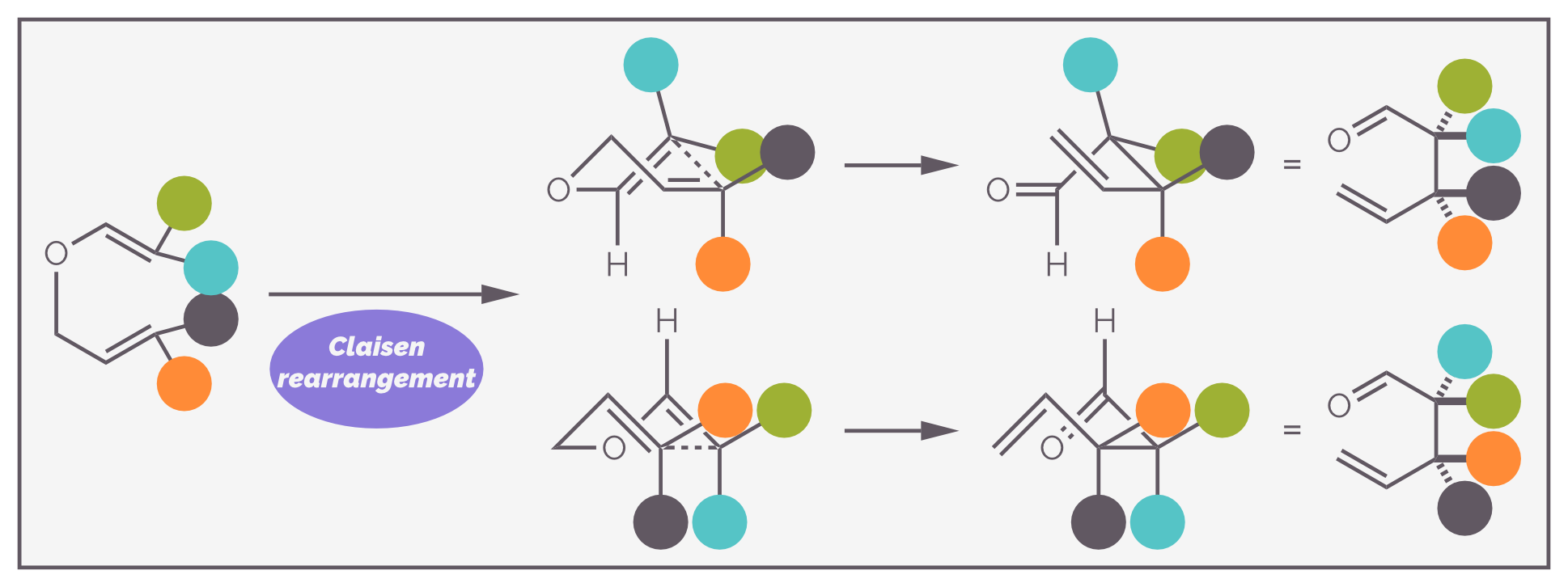
Steric factors can force the Claisen rearrangement to proceed through a boat-like transition state and this alters the relative stereochemistry of the two new stereocenters compared to the chair-like transition state.
The preference for Claisen rearrangements to proceed through a chair-like transition state means an existing stereocenter at the ethereal C–O bond will influence the stereochemistry of the final product. In the example below, the rearrangement can proceed through two different conformations, in one, the methyl substituent of the stereocenter is in the axial position and suffers from 1,3-diaxial interactions. It is disfavored. In the other, the methyl group is in the preferred equatorial position and the reaction proceeds this way to give the products in a ratio of > 99:1. Note, the products are not enantiomers, the geometry of the alkene has also changed. As diastereoisomers, it might be possible to separate them by simple chromatography.
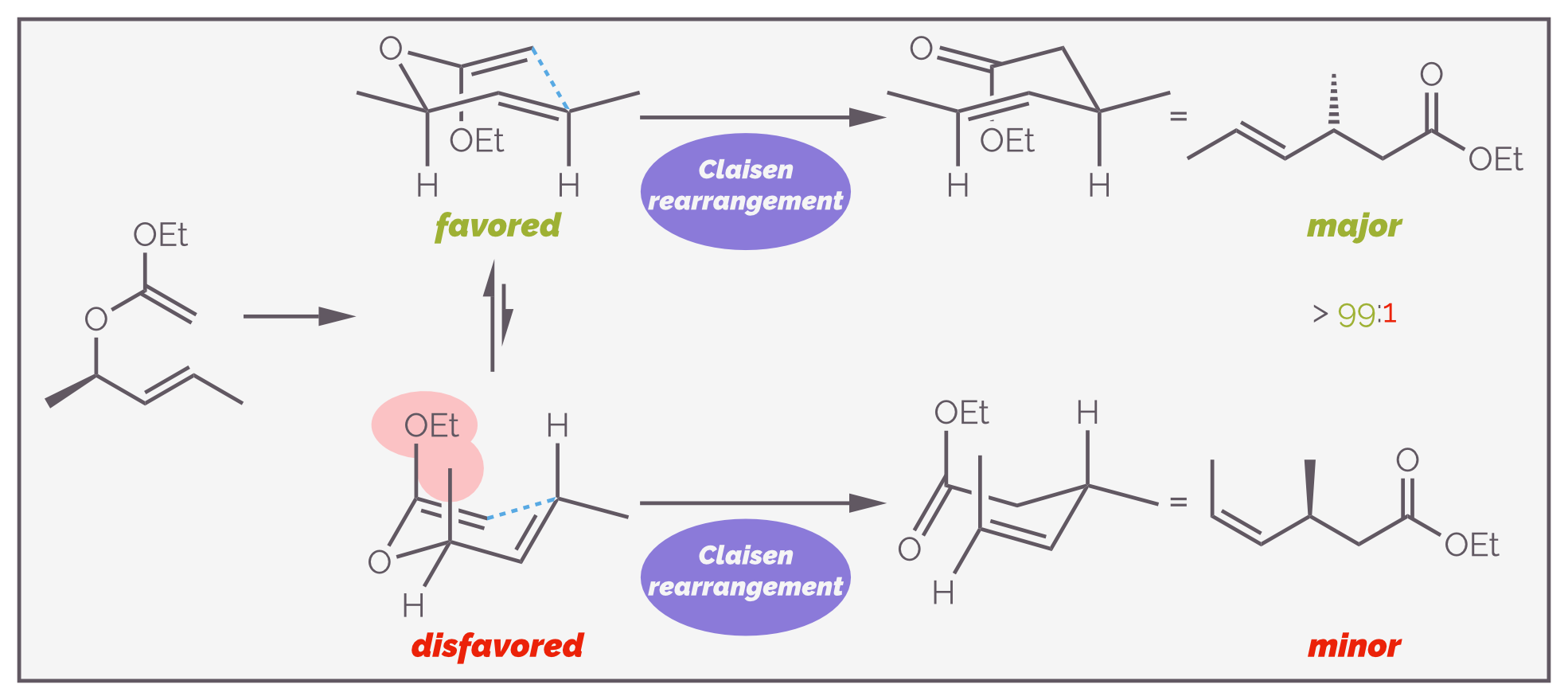
A stereocenter at the ethereal C–O bond (or alcohol position) will influence the stereochemistry of the final product. The favored conformation is a chair-like transition state with the methyl group of the stereocenter in the equatorial position, minimizing 1,3-diaxial interactions. The preference for one conformation over another controls both the geometry of the new alkene and the freshly installed stereocenter.
The predictable transfer of stereochemistry in such rearrangements allowed allowed the development of a stereoconvergentprocess in which two enantiomeric alcohols could be converted to the same product simply by controlling the geometry of the alkene in the rearrangement precursor (or controlling the diastereomer of the precursor).
The chemistry is taken from the synthesis of α-tocopherol and starts from a racemic alcohol. First resolution separates the enantiomers. Each is hydrogenated (partial reduction of the alkyne to an alkene by the addition of hydrogen) using different reagents and this leads to different alkene geometries. The lefthand enantiomer is reduced to the E-alkene by a dissolving metal reduction, while the righthand enantiomer is treated to more conventional hydrogenation with Lindlar’s catalyst to give the Z-alkene.
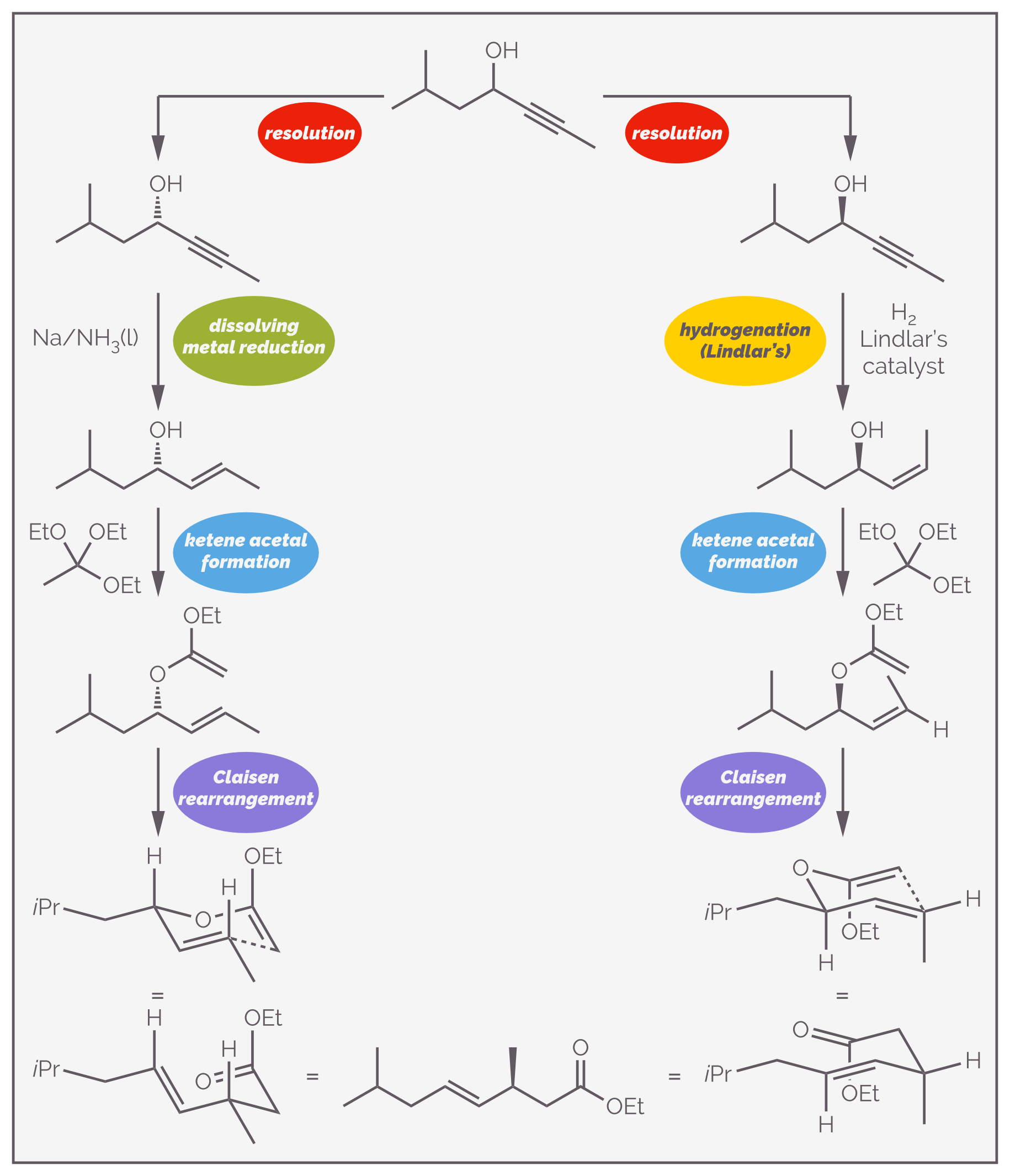
A racemic mixture of alcohols can be converted in the same enantiomer of an ester by controlling the stereoselective reduction of the alkyne. The diastereomeric (as the two compounds differ by the geometry of alkene and the stereocenter) alkenes undergo a predictable rearrangement through a chair-like transition state and this leads to the same compound.
The two allylic alcohols are best described as diastereomers as they only differ by stereochemistry (both the stereocenter and the geometry of the alkene). Both allylic alkenes are transformed into ketene acetals by condensation with triethyl orthoacetate. This sets up the molecules for the Claisen rearrangement (or a named modification of the Claisen rearrangement; see below). The rearrangements proceed through chair-like transition states. In both cases, the only choice is the orientation of the large alkyl group. This will be in the equatorial position. The orientation of the key methyl group is fixed by the geometry of the alkenes.
Variations of the Claisen Rearrangement
There are numerous variants of the Claisen rearrangement, this is one of the reasons it is so useful! Many of the variants are named reactions but don’t let this fool you into thinking that they are different. They differ from the original by how the rearrangement precursor is formed or which carboxylic acid derivative is formed at the end of the process but the mechanism is always the same. The most common are listed below.
You met the Johnson-Claisen rearrangement in the example above. The rearrangement precursor is prepared by reaction of an allylic alcohol with an ortho ester and it leads to the formation of an ester as the cartoon below shows. The reaction requires relatively high temperatures to proceed (100 - 200 °C).
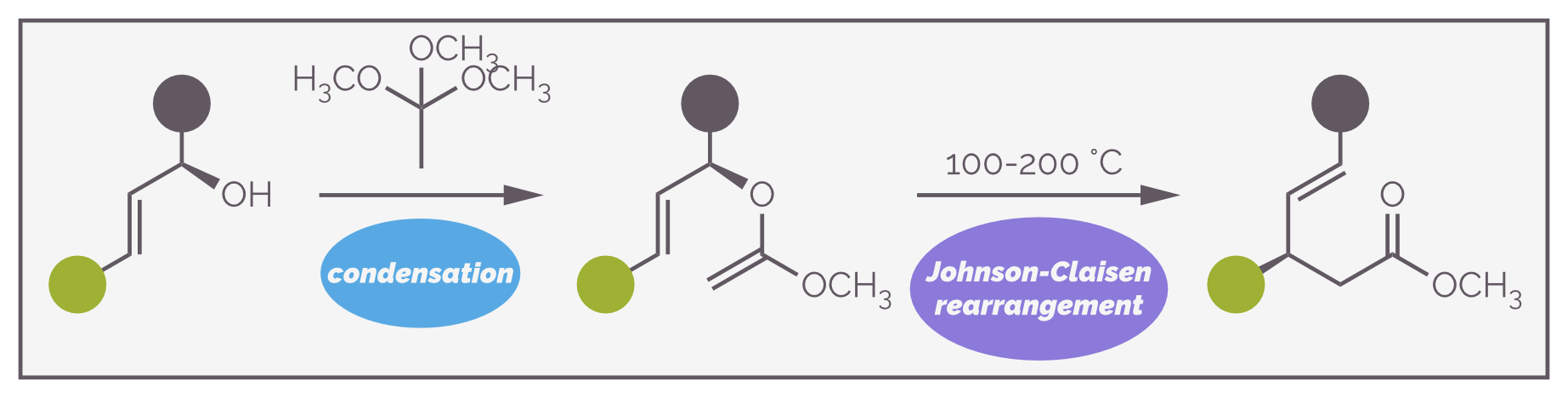
The Johnson-Claisen rearrangement involves the reaction of an allylic alcohol with an ortho ester to give a γ,δ-unsaturated ester.
The amide version of this reaction is called the Eschenmoser-Claisen rearrangement. It uses N,N-dimethylacetamide dimethyl acetal as the nitrogen version of an ortho ester. It should be apparent that the only difference is the presence of the nitrogen.
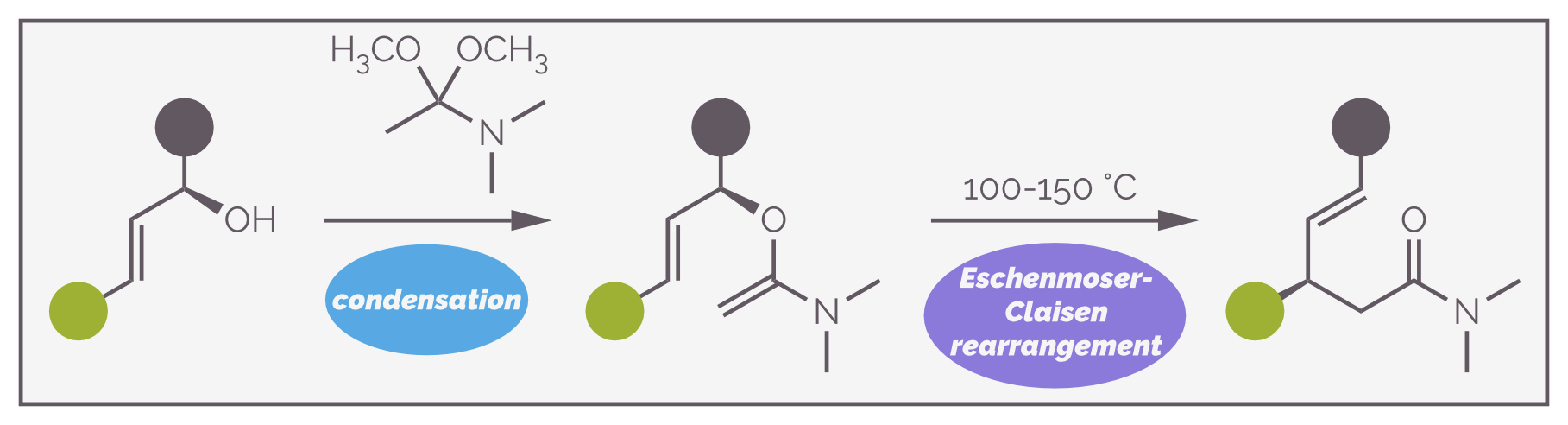
The Eschenmoser-Claisen rearrangement reacts an allylic alcohol with succinctly named N,N-dimethylacetamide dimethyl acetal to form a precursor that rearranges to give an unsaturated amide.
The mechanisms for the formation of the rearrangement precursors for both the Johnson-Claisen and Eschenmoser-Claisen are similar and I've shown the Eschenmoser variant below. Under the mildly acidic conditions, the nitrogen lone pair kicks out methanol to form an iminium-like cation that reacts with the allylic alcohol. After elimination of a second equivalent of methanol, the rearrangement precursor is formed. After that it is the rearrangement.
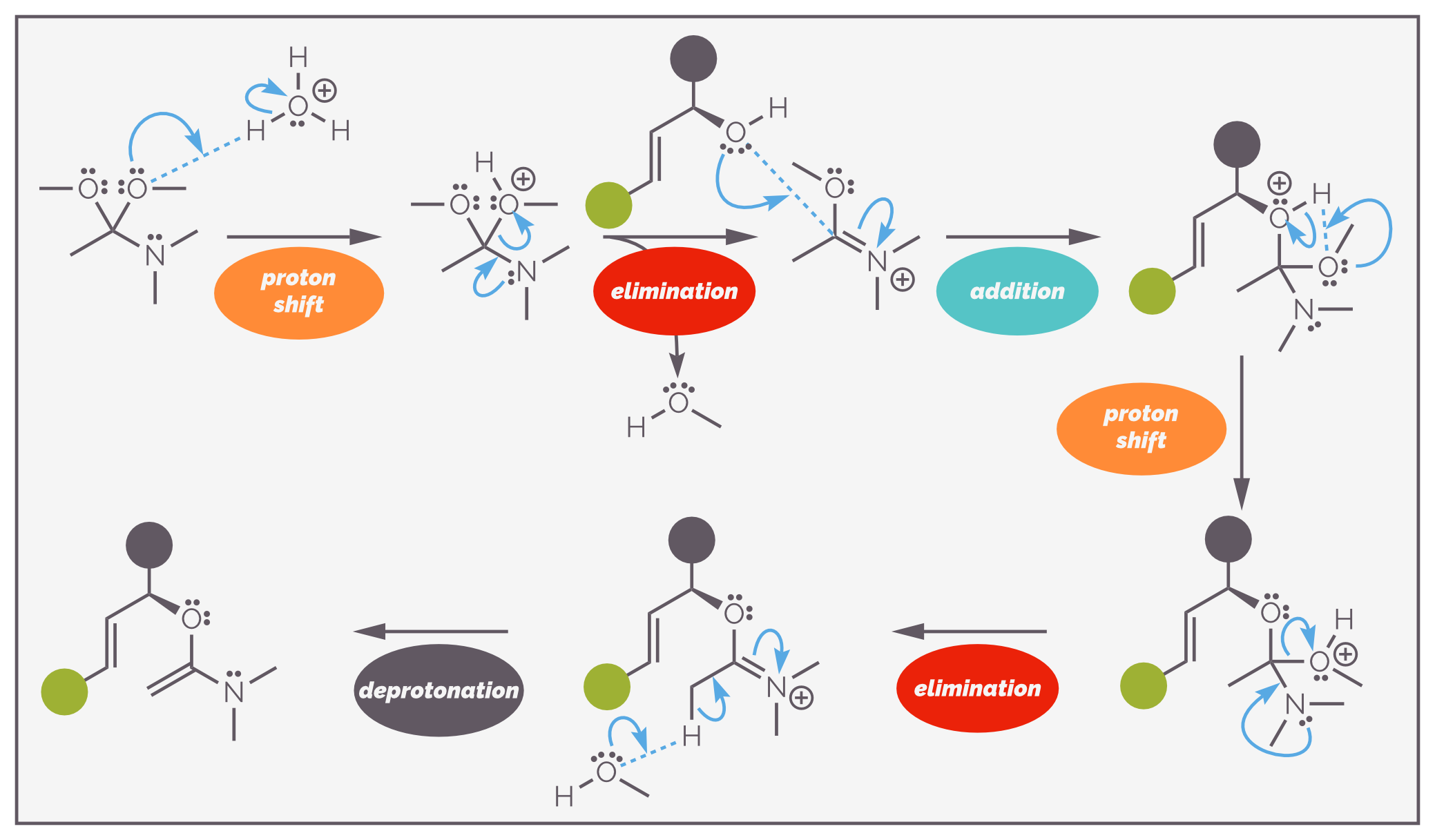
The mechanism of the Eschenmoser-Claisen rearrangement. Protonation creates a good leaving group that is kicked out to form an iminium-like intermediate. The alcohol adds to this. There is a proton transfer to convert another methoxy group into a leaving group. This is kicked out to give another iminium-like intermediate. Finally, deprotonation leads to the rearrangement precursor.
The final variant is the Ireland-Claisen rearrangement of ester derivatives. This reaction is a mild version of the Claisen rearrangement that often proceeds at room temperature or below. It has the driving force of the standard Claisen rearrangement, the formation of a carbonyl group but it combines this with a second oxygen atom that can be considered as either an oxy-anion or its equivalent. This means it is reminiscent of the oxy-Cope rearrangement and is similarly accelerated. The second advantage of the Ireland-Claisen rearrangement is that chemists have developed numerous methods to control the geometry of the enolatethanks to the aldol reaction. Enolate geometry can be used to control stereoselectivity with the E and Z-enolates giving different relative stereochemistry in the final product as shown below:
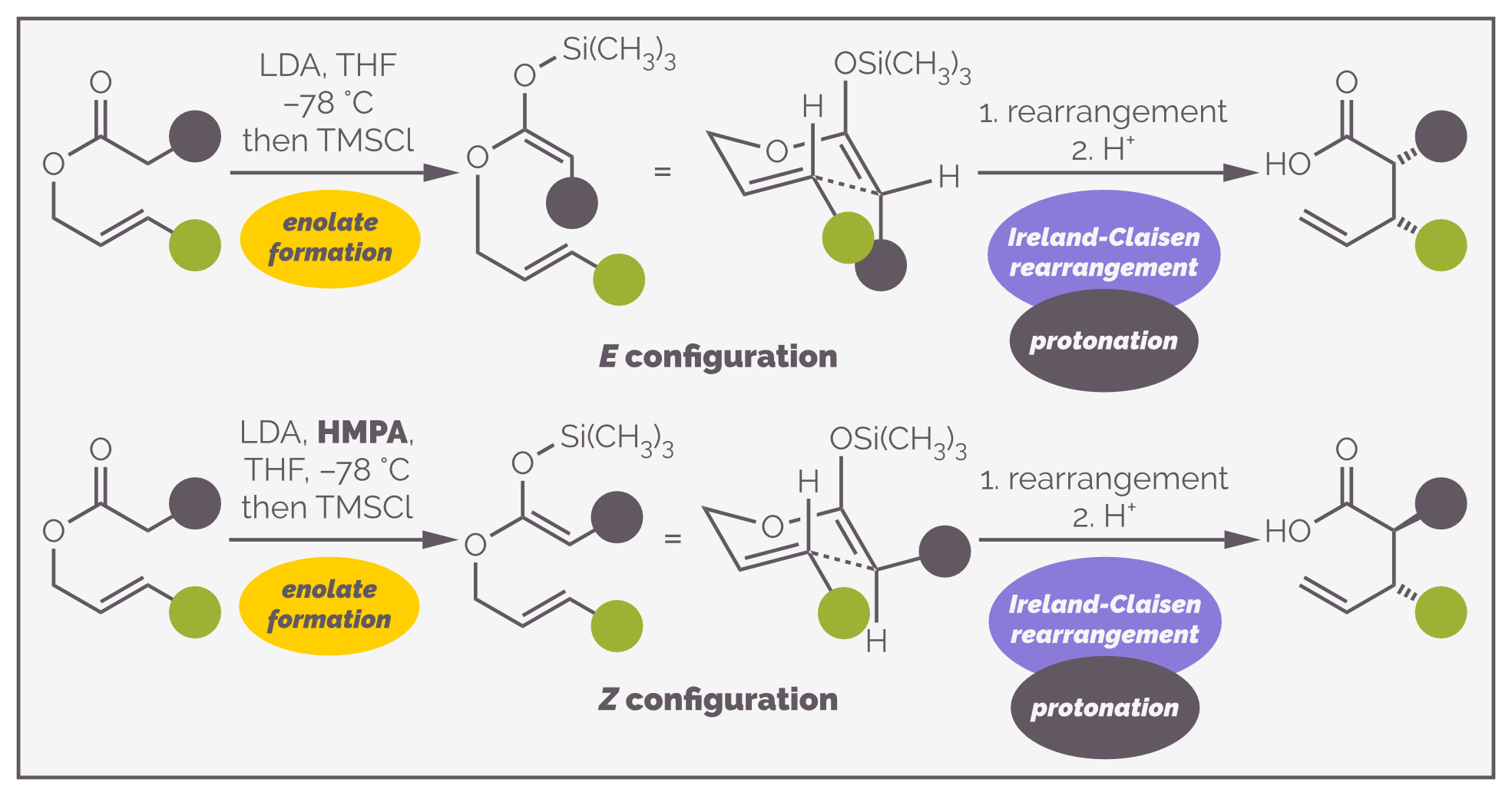
The Ireland-Claisen rearrangement involves the [3,3]-sigmatropic rearrangement of silyl ketene acetals. The precursor is easy to synthesize with good control of the enolate geometry. This in turn transfers to good control of the relative stereochemistry of the final product. The rearrangement occurs at low temperature and is one of the mildest variants of the Claisen rearrangement.
The Ireland-Claisen rearrangement is popular due to its mild reaction conditions and the exquisite control over stereochemistry that can be achieved in the C–C bond forming reaction simply by controlling the geometry of the enolate equivalent.
Conclusion
This summary has covered the most common [3,3]-sigmatropic rearrangements, the (oxy)-Cope rearrangement and the Claisen rearrangement, along with some of its many variants. The rearrangements share a motif with two C=C bonds two atoms apart. In its simplest form, this means a 1,5-diene. The mechanism involves six electrons or three curly arrows moving in a circle. The reaction is concerted and proceeds through a cyclic transition. This often allows good control of stereochemistry.
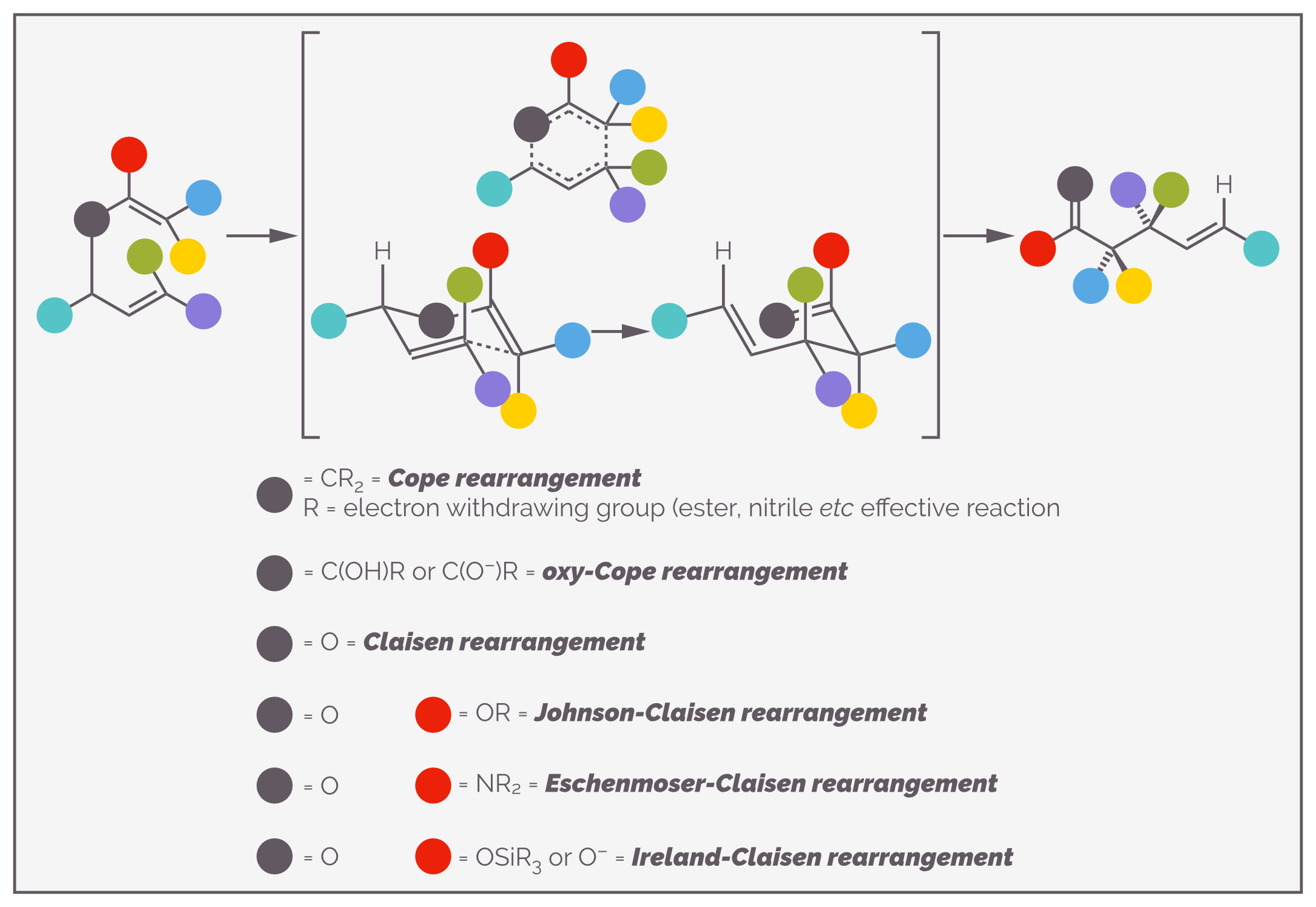
A cartoon showing the general structure of [3,3]-sigmatropic rearrangements. It shows that such rearrangements can be highly stereoselective. There is a list of some of the named variants based on the substituents.
The Cope rearrangement is reversible and the structure must be biased towards one side of the reaction to get a meaningful yield. This can be achieved by increasing the substituents on the alkenes of the desired product or running them into conjugation with a suitable electron withdrawing group ● = C(EWG)2.
Another method to drive the Cope reaction forward is to add an alcohol group as a substituent of ● (in the diagram above). This leads to the rearrangement forming an enol ether or equivalent that irreversibly isomerizes to a carbonyl group (not exactly true as there is keto/enol tautomerization but it’s close enough), driving the reaction in one direction. Deprotonation of the hydroxyl group results in an alkoxy anion and the anionic oxy-Cope rearrangement, which is a particularly rapid variant.
The Claisen rearrangement is more efficient than the Cope rearrangement as it delivers a carbonyl group that drives the reaction in one direction. The efficiency of the reaction, in conjunction with the ease of precursor preparation, acylation and/or deprotonation, make this reaction popular. There are a number of named variants of the Claisen rearrangement depending on how the rearrangement precursor is synthesized or the nature of the carboxylic acid derivative that is formed after rearrangement. Of these, the Ireland-Claisen rearrangement is probably the most useful because of the various methods of controlling the geometry of enolates and how this translates into control of the stereochemistry of the final product.
This summary has just been an introduction to a fascinating topic. There are many stereoselective variants of these rearrangements that use Lewis acid catalysts or organocatalysts. The reliability of the rearrangement means it is an excellent method to create C–C bonds from easily made precursors and this has led to the use of these reactions in numerous total syntheses.
There are many other sigmatropic rearrangements, I have only covered [3,3] rearrangements. There are [2,3]-rearrangements such as the Wittig rearrangement or [1,n]-hydride shifts (and, of course, with my wonderful description above you can determine these names for yourself). I might return to this subject at a later date.
![There are other types of sigmatropic rearrangement including [2,3]-sigmatropic rearrangements, such as the Wittig rearrangement of allylic ethers shown above, and [1,5]-hydride shifts as illustrated by the second reaction.](https://images.squarespace-cdn.com/content/v1/62185f3b81809a6fd03ddbb5/bc8e5620-a093-4e98-8828-2d046cc95a6b/27_Other_Rearrangements.png)
There are other types of sigmatropic rearrangement including [2,3]-sigmatropic rearrangements, such as the Wittig rearrangement of allylic ethers shown above, and [1,5]-hydride shifts as illustrated by the second reaction.