
Introduction
The last two summaries have outlined the Diels-Alder reaction, a concerted pericyclic cycloaddition between a diene and a dienophile. The reaction proceeds through a six-electron Hückel aromatic transition state involving [4+2] electrons. The reaction can also be classified by counting the atoms involved, in which case the Diels-Alder reaction is a (4+2) cycloaddition where the change from square brackets to brackets (for the English amongst us or parentheses for everyone else) denotes that you are now counting atoms. The Diels-Alder reaction can involve atoms other than carbon, and is then known as a hetero-Diels-Alder reaction, but it will always be a [4+2] or (4+2) cycloaddition. A simple example of Diels-Alder reaction is given below:
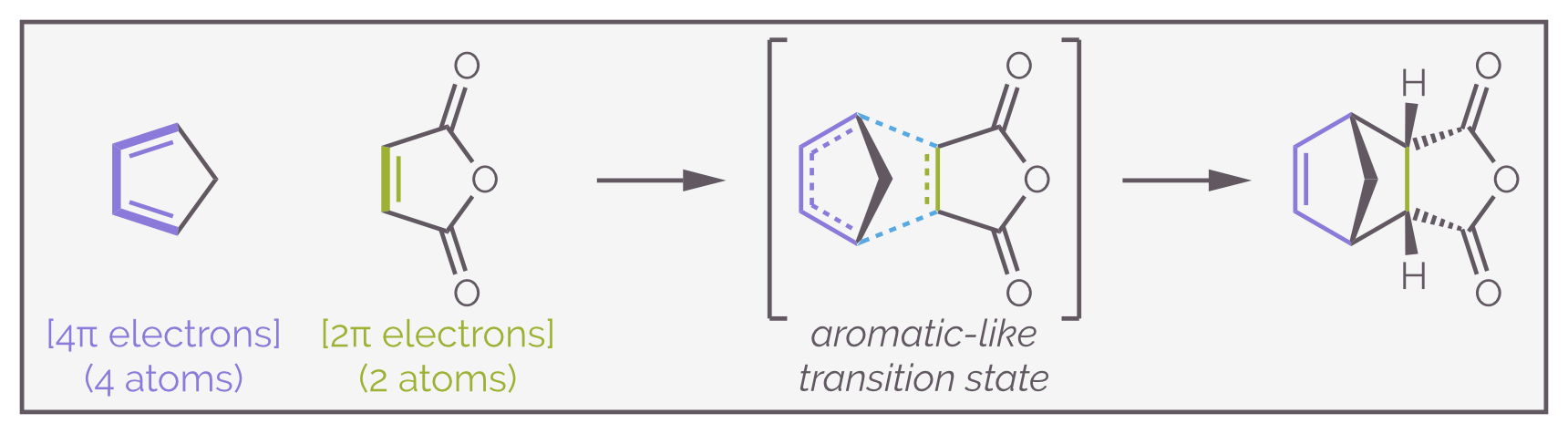
The Diels-Alder reaction is an example of a [4+2] cycloaddition, which means on component has four π electrons and the other has two π electrons. It is also an example of a (4+2) cycloaddition. This time the numbers refer to the number of atoms in each of the reactants. Cycloadditions are concerted reactions that proceed through a aromatic-like transition state that results in them being highly selective.
It is possible to form five-membered rings through a similar pericyclic reaction that still involves [4+2] electrons but now only has (3+2) atoms. Such reactions are known as 1,3-dipolar cycloadditions and a general example is shown below. A 1,3-dipole reacts with a dipolarophile, in this case a molecule with a double bond, to give a five-membered ring. The similarities to the Diels-Alder reaction should be apparent.
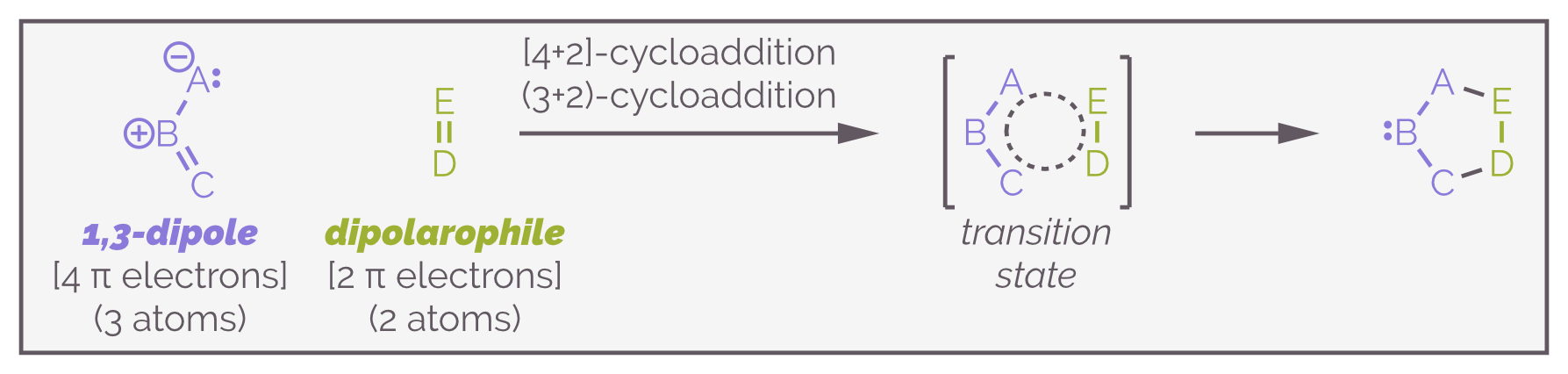
A general representation of a 1,3-dipolar cycloaddition. It involves a 1,3-dipole that has four π electrons and three atoms that react with a dipolarophile that has two π electrons and two atoms.
1,3-Dipoles are, unsurprisingly, dipolar molecules. This means they are electronically neutral species yet formally carry both positive and negative charges (if you cannot determine formal charges, there is a quick reminder HERE). The electrons are delocalized and must have the charges separated over three atoms in at least one of the resonance structures. Invariably, at undergraduate level, the central atom of the 1,3-dipole will be either nitrogen or oxygen; in the diagram below B ≠ carbon. There are four π electrons, this is a [4+2] cycloaddition after all, with two of these electrons being part of a multiple bond while the other two are the lone pair of electrons of a negative charge. The key to the reactivity of 1,3-dipoles is that that the two terminal atoms can be either nucleophilic or electrophilic. While the central atom has a formal positive charge, it is not an electrophile. Arguably, the 1,3-dipole should have the formal charges on atoms 1 and 3 but this is invariably the resonance structure that contributes the least to the overall structure and 1,3-dipoles are always drawn with the formal charges on adjacent atoms.
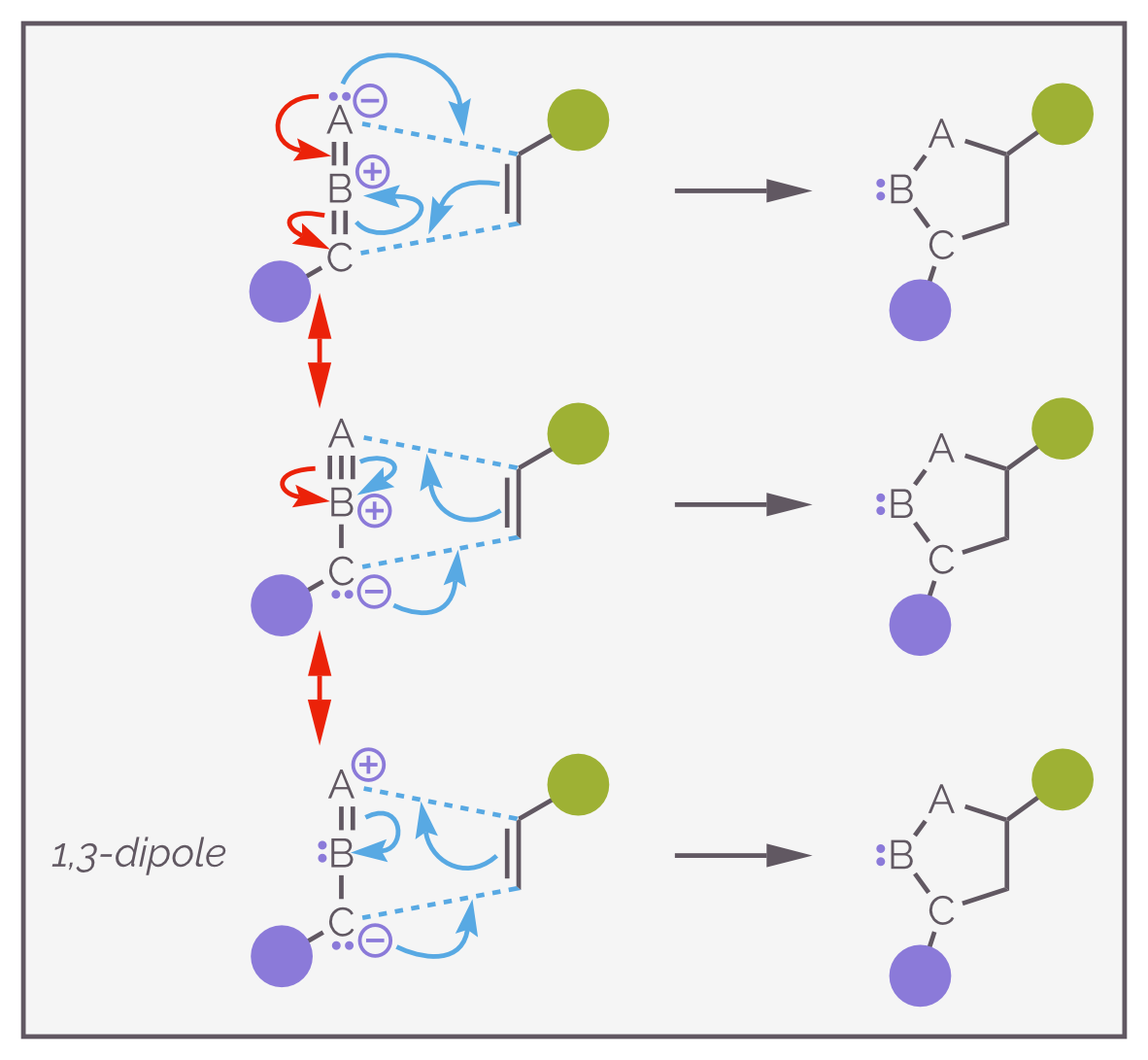
1,3-Dipoles are always drawn with formal charges on the 1 and 2 atoms but there must be a resonance structure with the formal charges on the 1 and 3 atoms. Any of the resonance structures can be used in the curly arrow mechanism. This shows that either terminal of the 1,3-dipole is the nucleophile (with the other being the electrophile). For clarity, the resonance curly arrows only show the electron redistribution in one direction. Arguably, drawings of resonance should show the redistribution in both directions, emphasizing that the electrons are spread over the three atoms.
The 1,3-dipoles are termed either linear if the three atoms are in a straight line and comprise of two sp hybridized atoms and one sp2 hybridized atom, or they are called bent (sometimes trigonal) dipoles. These comprise of three sp2 hybridized atoms. The shape does not influence their reactivity.
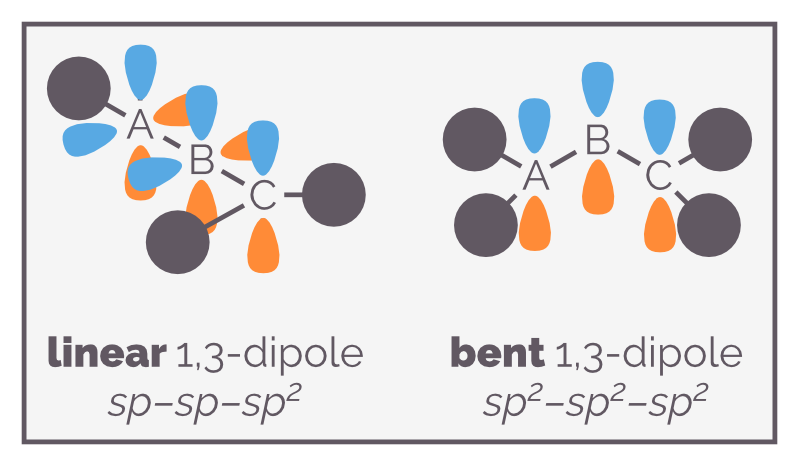
1,3-Dipoles can be either linear, the three atoms of the dipole are in a straight line, or they are bent. This does not influence the reactivity.
The dipolarophile can either be an alkene or an alkyne. It is normally substituted to help determine selectivity but 1,3-dipolar cycloadditions are not as sensitive to electronics as the Diels-Alder reaction. It is hard to make generalizations about either regio- or stereo-selectivity. The reaction can involve the overlap of the HOMO(dipole) with the LUMO(dipolarophile) or vice-versa with the HOMO(dipolarophile) reacting with the LUMO(dipole). There is no such thing as a normal or inverse demand 1,3-dipolar cycloaddition (compare with the Diels-Alder reaction HERE). Reactions readily occur when the gap between the HOMO and LUMO is small and this means the dipolarophile often has either a strongly electron donating substituent or a strongly electron withdrawing substituent. The regioselectivity can often be predicted by looking at the electronics but steric hindrance plays a more important role than it did in the Diels-Alder reaction.
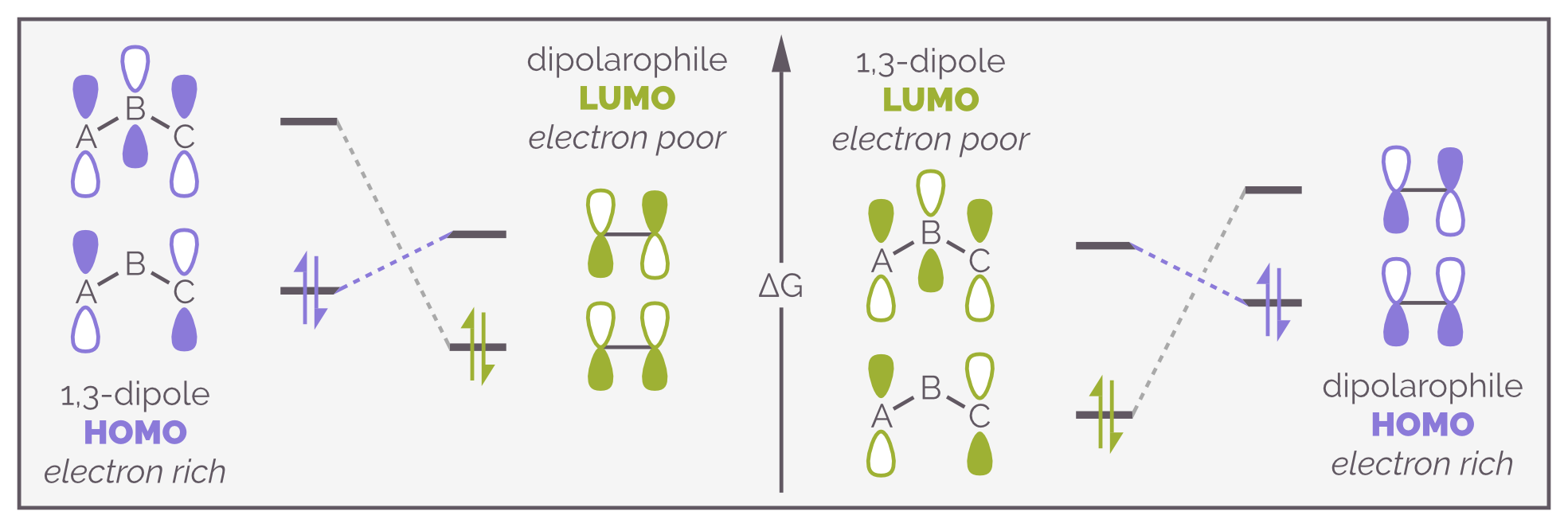
Cartoon of the molecular orbital interactions for a 1,3-dipolar cycloaddition. The 1,3-dipole can be either the nucleophile or the electrophile depending on the relative energies of the dipole and dipolarophile. While one combination might be termed ‘normal’ and the other ‘inverse demand’, this terminology is nearly never used in 1,3-dipolar cycloadditions.
As with the previous summaries, this is only a brief outline or introduction to these fascinating reactions and focuses mainly on the reactions rather than the molecular orbital picture or the Woodward-Hoffmann rules. I’ll cover the reaction of azides with alkynes to give traizoles as this has become a cornerstone of many synthetic endeavours. Additionally, I’ll show the reaction of nitrile oxides with alkenes to give isoxazolines, the reaction of nitrones with alkenes to form isoxazolidines, and the reaction of azomethine ylides to give pyrrolidines. There are two common dipolar cycloadditions that I’m avoiding for the time being, the first is ozonolysis. The initial step of this reaction is a 1,3-dipolar cycloaddition but then things get a bit messy and I don’t want to muddy the waters. Similarly dihydroxylations, and related reactions, probably proceed through a dipolar cycloaddition but again, a lot more occurs afterwards so I’ll leave them for another day (if ever).
Azide-Alkyne Cycloaddition
The 1,3-dipolar cycloaddition of an azide to an alkyne to give a triazole has become one of the most common examples of a cycloaddition reaction. Sometimes, erroneously, called the ‘click' reaction, the metal-catalyzed version is an example of a ‘click' reaction, but this distinction is a discussion for another day. The uncatalyzed, thermal reaction of an azide and an alkyne leads to a mixture of regioisomeric triazoles and isn’t as useful (or common) but I’ll start here to cover the basics.
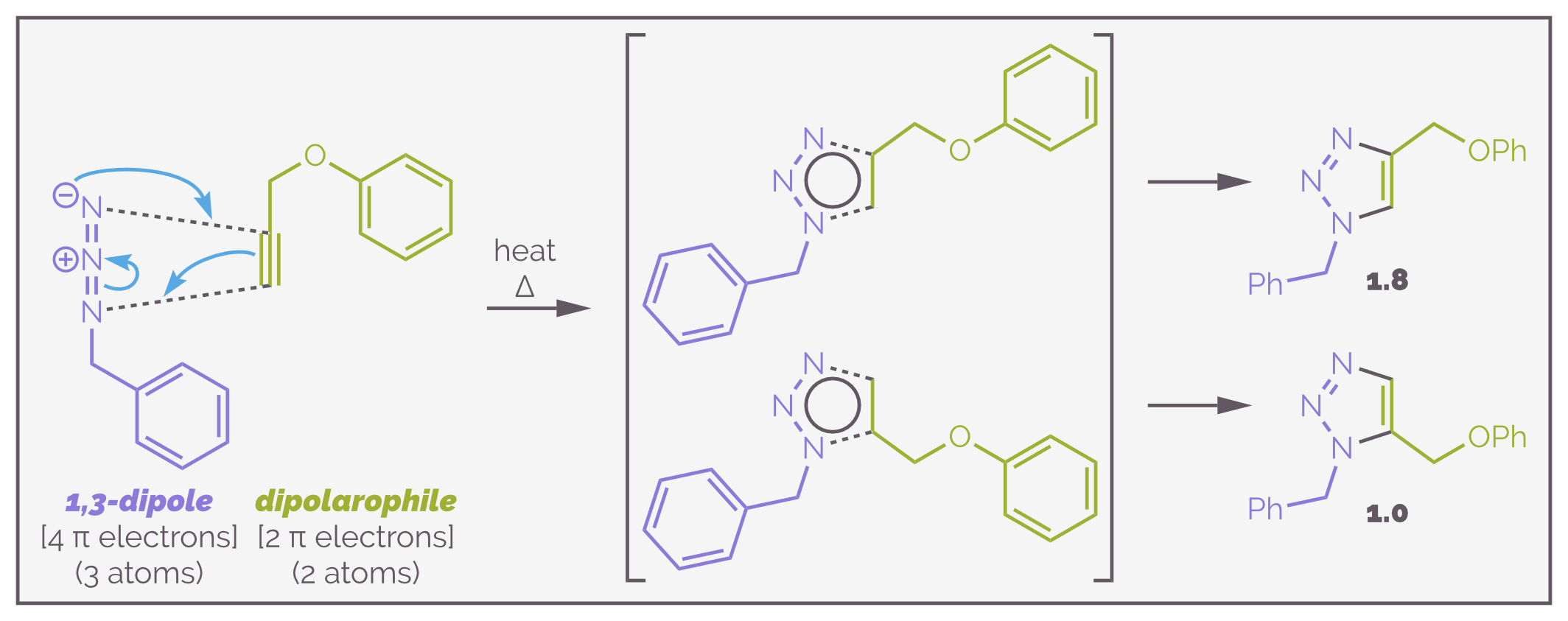
An example of a thermal 1,3-dipolar cycloaddition between an azide, a linear dipole, and an alkyne. The reaction shows little regioselectivity and this selectivity is driven by steric repulsion of the substituents.
The azide is the 4π electron, three atom component. As an azide is a linear arrangement of atoms, it is known as a linear dipole or linear 1,3-dipole. The dipole is zwitterionic, containing both a formal positive charge and a formal negative charge. The charges are resonance stabilized, with the electrons delocalized over the three atoms of the dipole.
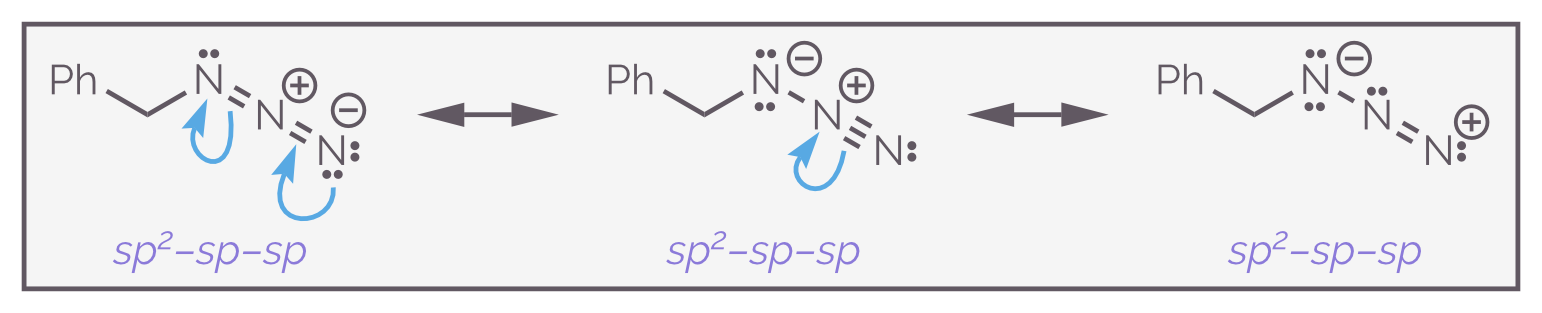
Azides are 1,3-dipoles with the formal charges stabilized by resonance. The first representation is the most common drawing of an azide with the last demonstrating that these are 1,3-dipoles but contributing the least to the overall structure. Azides can be though of as sp2-sp-sp systems and this gives an indication of which π electrons are involved in a cycloaddition. Some of my colleagues would argue that the hybridization changes with each resonance structure (e.g. the first structure is sp2-sp-sp2) but this makes no sense to me as it implies the shape of the molecule changes in each resonance structure. I suggest the hybridization must work for all resonance structures. For clarity, the resonance curly arrows only show the electron redistribution in one direction. Arguably, drawings of resonance should show the redistribution in both directions, emphasizing that the electrons are spread over the three atoms.
The mechanism follows the general reaction given above and is similar to the Diels-Alder reaction with three curly arrows representing the movement of six π electrons. Depending on the resonance structure, the arrows can be pushed either clockwise or anticlockwise and this highlights the aromatic characteristics of the transition state.
There is little selectivity in the addition and they generally give mixtures of regioisomeric products. Steric hindrance influences the outcome, with the substituents of the ring tending to be opposite each other rather than on adjacent atoms.
If the last paragraph was the last word on triazole formation then this reaction would not have become so common. The important discovery was that the addition of a metal, often a copper(I) species, could dramatically improve the selectivity. The reaction is often made more user friendly by adding a copper(II) salt along with a mild reducing reagent. The copper(I) species reacts with the alkyne first to give a copper acetylide (see below). The regioselectivity is controlled by the coordination of the azide to the copper acetylide, the substituents minimize steric interactions leading to them being opposite each other. Cycloaddition occurs to give a copper triazole species that is eventually protonated to give the final product. The mechanism is undoubtedly more complex than I have drawn here, and involves two copper species, but this simplification allows you to usefully predict the outcome of the reaction.
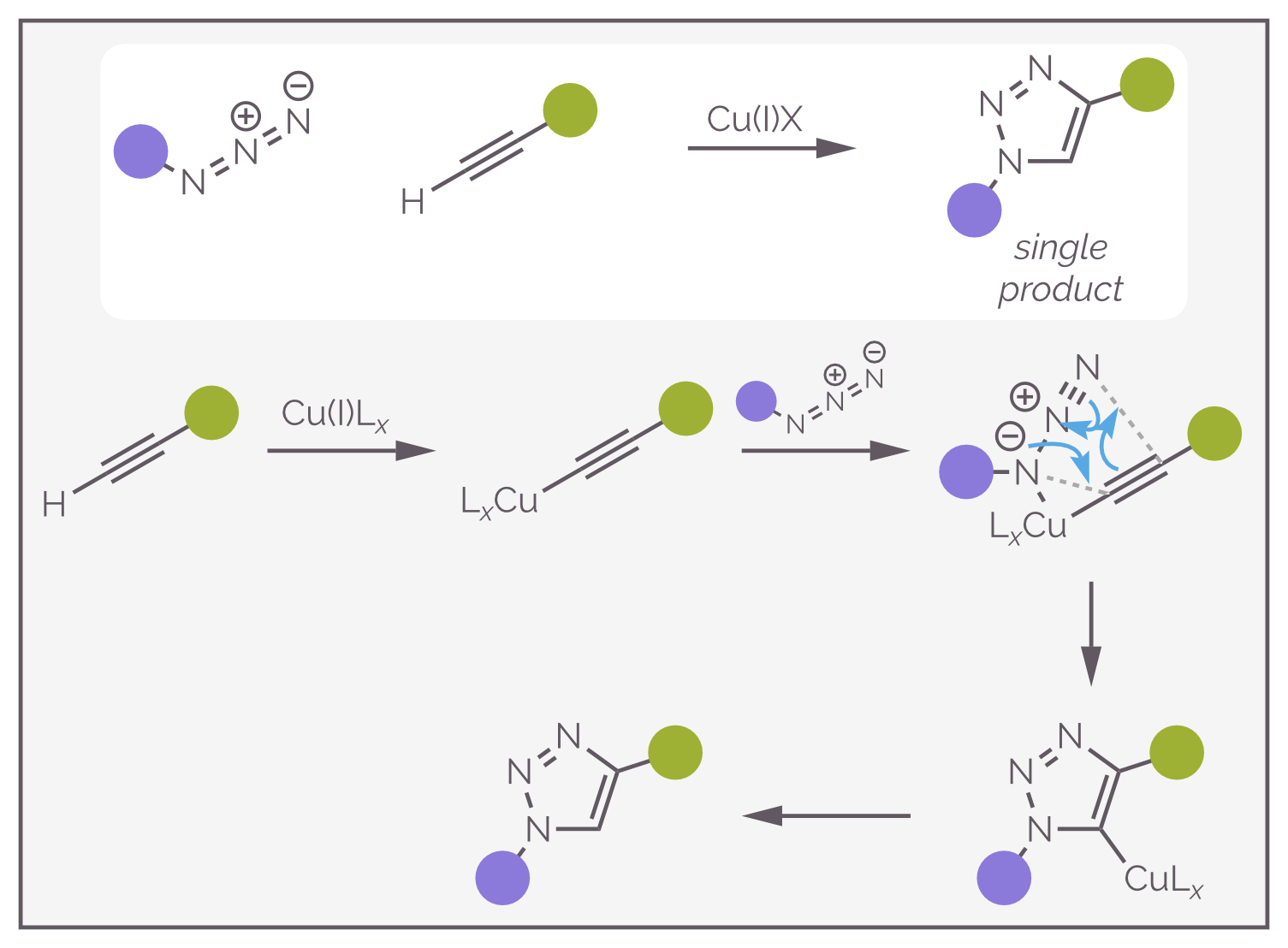
Generalization of a copper(I)-catalyzed alkyne-azide cycloaddition. The cycloaddition now proceeds with excellent regioselectivity. A simplified form of the mechanism is given below the reaction. The real mechanism almost certainly involves two metals.
This metal-catalyzed cycloaddition allows two relatively unreactive molecules to be coupled under mild conditions. It has become the cornerstone of numerous syntheses of functional materials and has been used to modify biological systems. The reliability of the reaction, the fact that a vast array of alkynes and azides can be coupled under almost identical conditions, has led to this reaction being termed a 'click reaction’, a reaction that just works and clicks two molecules together. The success of this metal-catalyzed cycloaddition led to Barry Sharpless winning his second Nobel Prize for chemistry along with Carolyn Bertozzi and Morten Meldal.
The Cycloaddition of Nitrile Oxides
Our second 1,3-dipolar cycloaddition involves another linear dipole, this time nitrile oxides. These react with alkenes to give isoxazolines, heterocycles that are effectively masked aldol products. This means they are readily converted into the product of an aldol reaction, a β-hydroxy ketone. They can also be transformed into amino alcohols, making them versatile intermediates.
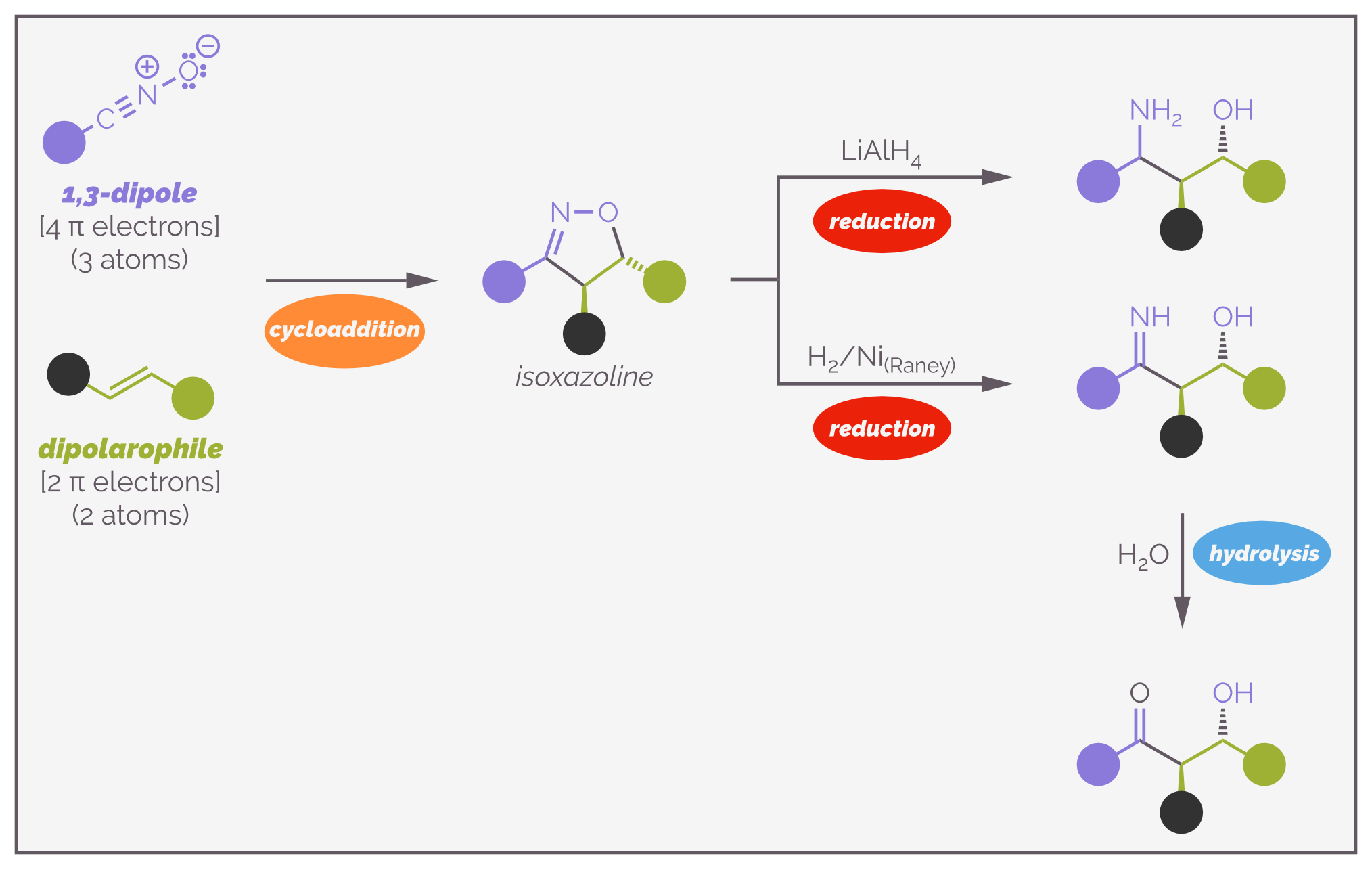
The cycloaddition of a nitrile oxide, a linear 1,3-dipole, and an alkene to give an isoxazoline. The isoxazoline can be transformed into a β-amino alcohol by reduction with lithium aluminium hydride or into a β keto alcohol by hydrogenation with hydrogen gas and Raney nickel followed by hydrolysis with water.
As this is a cycloaddition, it is considered a concerted reaction with all the bonds being made and broken at the same time. This means the geometry of the alkene or dipolarophile is conserved in the stereochemistry of the product. The reaction is stereospecific. This is apparent if you look at the cycloaddition of the two different alkenes as shown below:
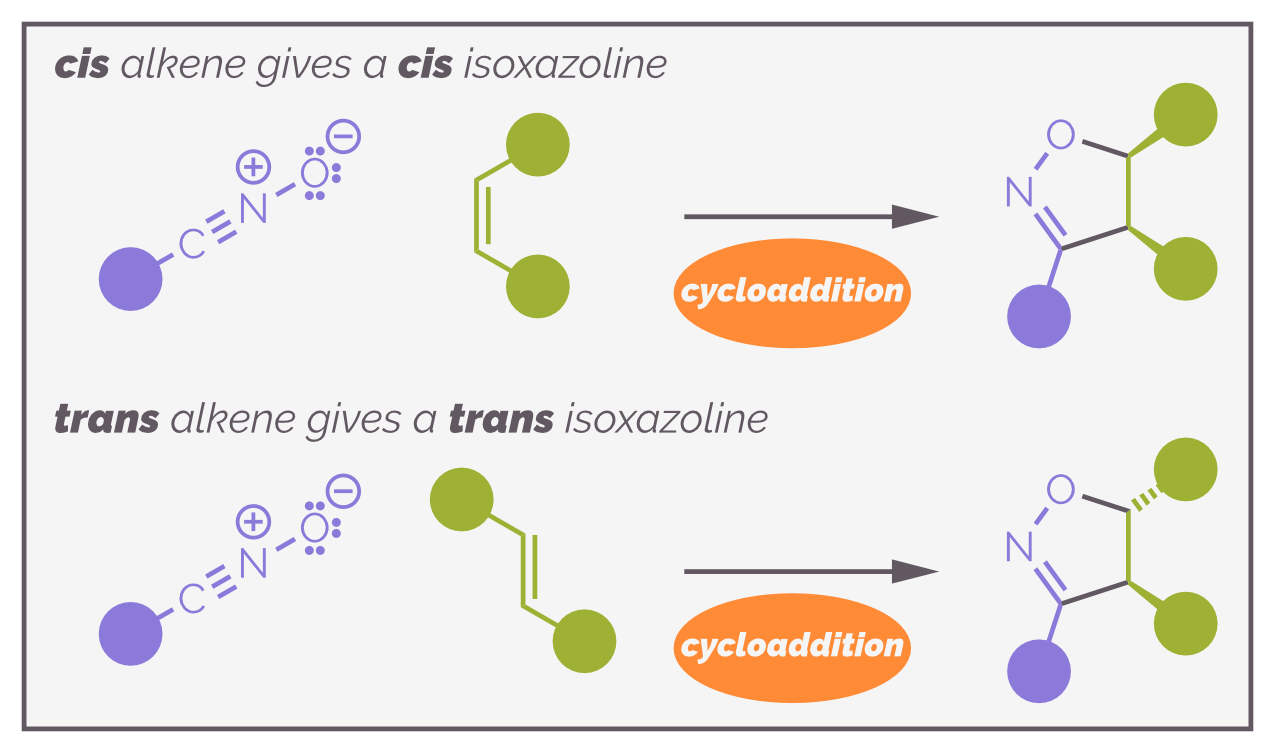
Cycloadditions are concerted reactions and stereospecific with regards to the alkene or dipolarophile. This is shown by a cis alkene giving the cisisoxazoline and the trans alkene giving the trans product.
Nitrile oxides are highly reactive and are normally formed in situ. This means they are generated in the presence of the dipolarophile. Common methods for their synthesis include the oxidation of imines or the dehydration of nitro compounds. Oximes are formed by the condensation of hydroxylamine and an aldehyde (see HERE). Oxidation can be achieved with sodium hypochlorite, more commonly known as bleach. The first step is chlorination of the oxime, which probably occurs through the action of hypochlorous acid. The intermediate is likely to be an unstable nitroso species that eliminates hydrogen to give a chloro-oxime. The curly arrows are given below.
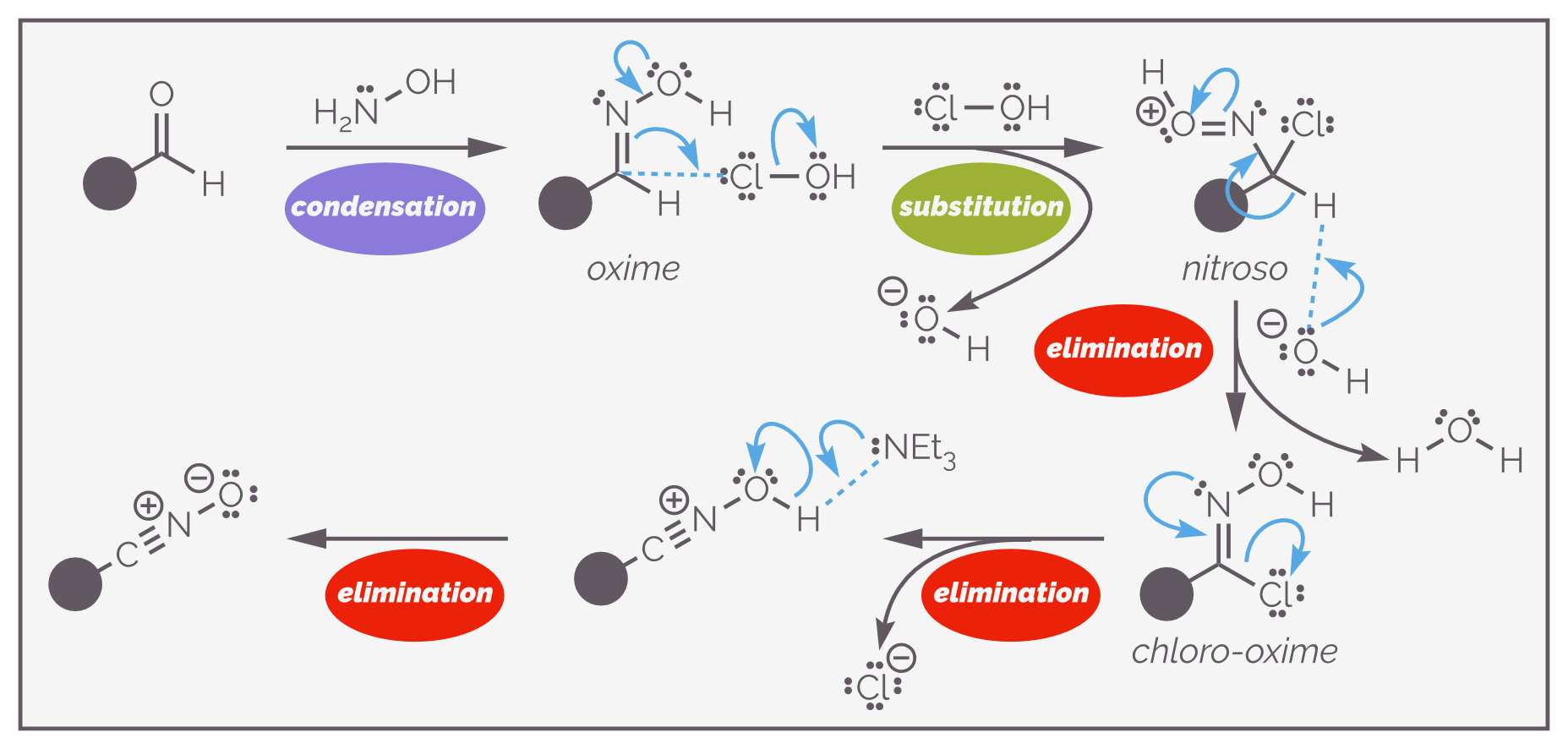
The mechanism for the formation of a nitrile oxide ylide from an aldehyde and hydroxylamine. The mechanism of the initial aldehyde/amine condensation is not given as this can be found in a previous summary. From the oxime onwards, there is a substitution to give a chloro nitroso intermediate that collapses to give a chloro oxime. Elimination of the chloride anion and deprotonation then gives the ylide.
The chloro-oxime is not stable and there is a second elimination. This time the chloride anion is expelled. Finally, the hydroxyl group is deprotonated. Overall there has been a formal γ-elimination but the mechanism is significantly different.
An example of this reaction is found in the synthesis of vinblastine (Ref: JACS 2002, 2137). An intramolecular cycloaddition forms the expected isoxazoline and a cyclohexane ring. The reaction is no different to above except the dipole and dipolarophile are joined. Reduction of the N–O bond in conjunction with a hydrolysis gives the cyclohexanone shown below. The first step of the reaction is formation of the nitrile oxide via the chloro-oxime. The exisiting stereocenter probably controls the conformation of the reactive intermediate. A chair-like transition state with the bulky protected alcohol pseudo-equatorial leaves the vinyl ethyl group pseudo-axial as shown below. This gives the observed diastereomer.
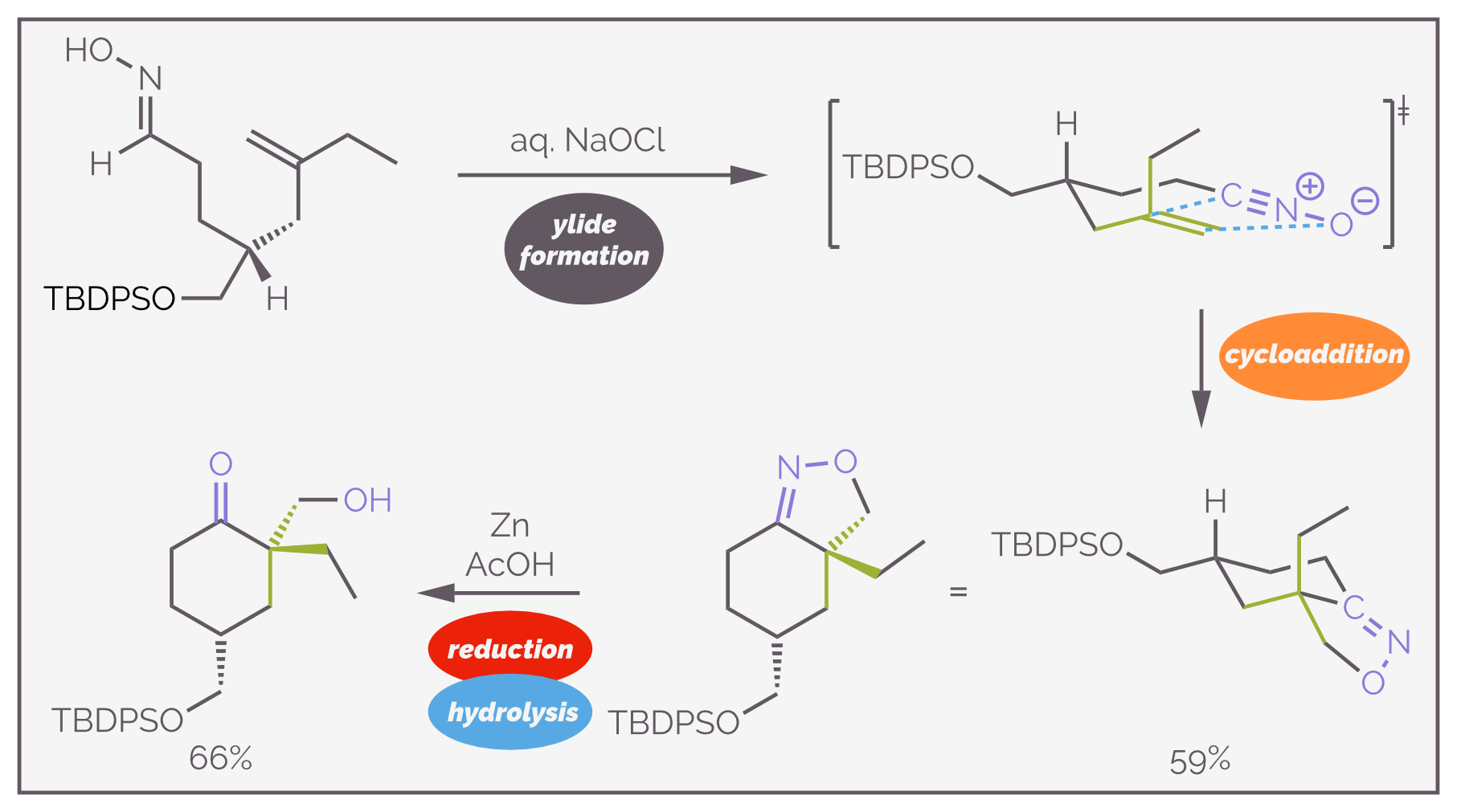
An example of a 1,3-dipolar cycloaddition taken from a synthesis of vinblastine. The nitrile oxide ylide is formed by chloro-oxidation of an oxime. Cycloaddition, possibly through a chair-like transition state, gives a fused five,six-ring system with the desired stereochemistry. Reduction and hydrolysis cleaves the N–O bond to give a β-hydroxy ketone.
The dehydration route to the nitrile oxide involves the reaction of a nitro group with phenylisocyanate to give the 1,3-dipole, aniline and carbon dioxide. The reaction probably starts with the nitro attacking the electrophilic carbon of the isocyanate. Next, a proton transfer is followed by rearrangement to give the three products. I have drawn the last step as if it was concerted but it could be stepwise, and ultimately doesn't matter.
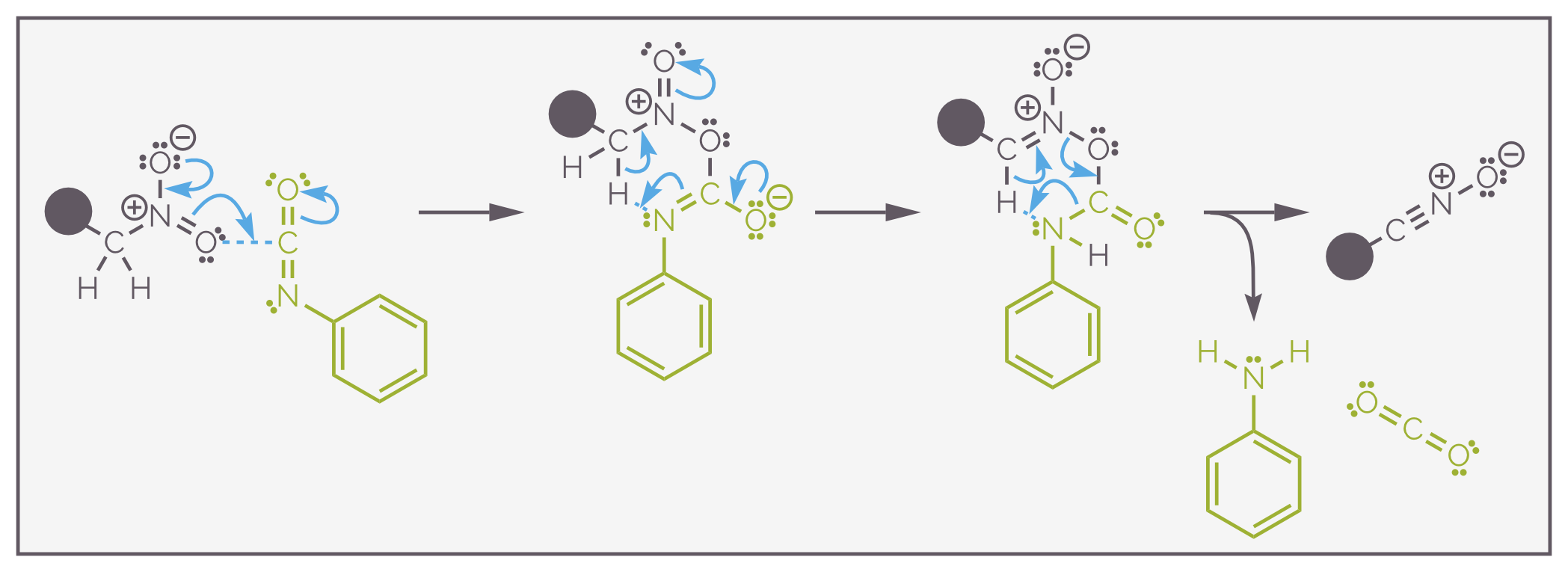
Nitrile oxides can be formed by the dehydration of nitro compounds. Reaction with an isocyanate leads to the formation of the 1,3-dipole, aniline and carbon dioxide. The last step of the mechanism may not be concerted but the scheme gives the general gist.
A classic example of this method for forming 1,3-dipoles comes from the synthesis of the vitamin biotin. Addition of phenylisocyanate leads to the formation of a nitrile oxide that spontaneously undergoes an intramolecular cycloaddition. The reaction is highly diastereoselective. The length of the chain linking dipole and dipolarophile means the nitrile oxide must attack from the same face as the initial stereocentre.
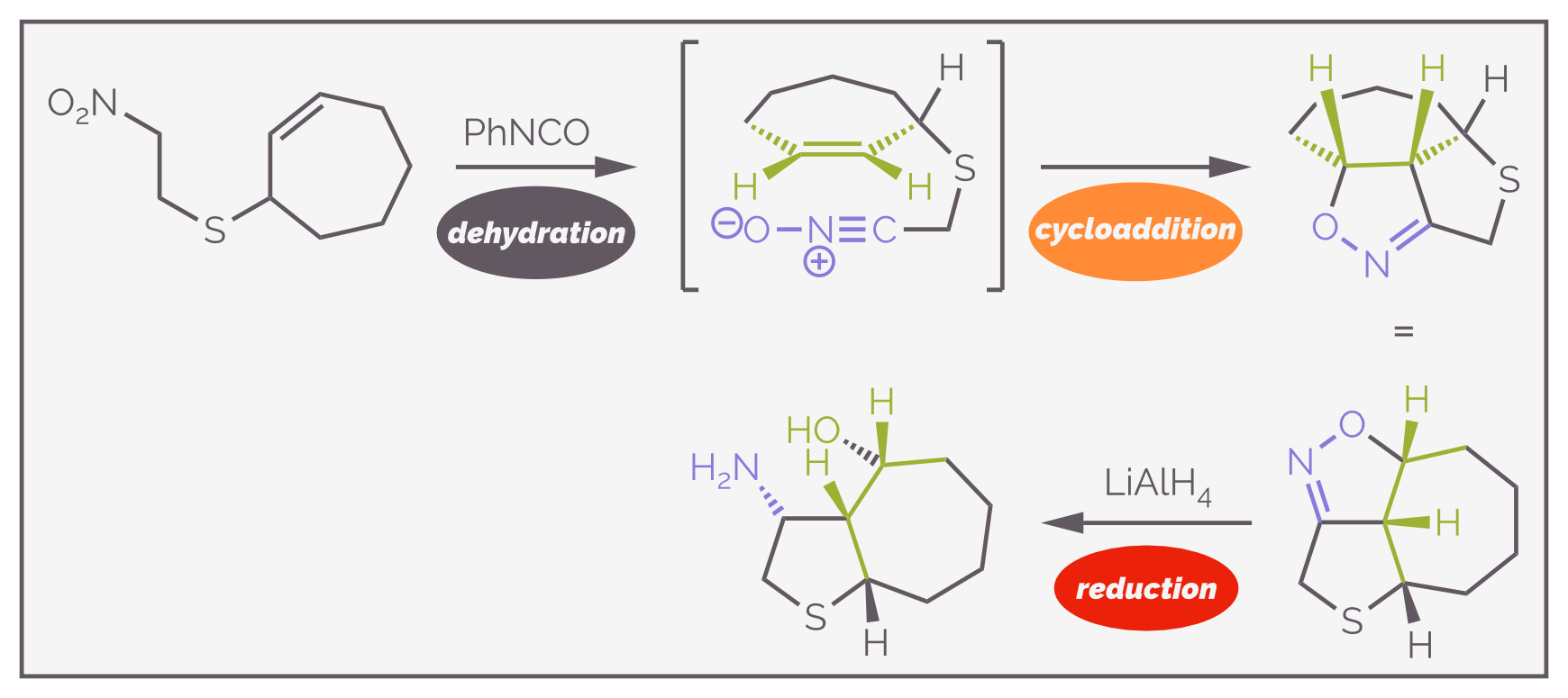
In this example, phenylisocyanate dehydrates the nitro group to form the reactive nitrile oxide. 1,3-Dipolar cycloaddition furnishes a tricyclic compound with the correct cis relative stereochemistry for the formation of biotin. Reduction cleaves one ring to give an amino alcohol.
The Cycloaddition of Nitrones
Nitrones are similar to nitrile oxides in that they contain a formally positively charged nitrogen and a formally negative oxygen but they are our first example of a bent 1,3-dipole. Nitrones are readily formed by the condensation of an alkyl hydroxylamine and an aldehyde.
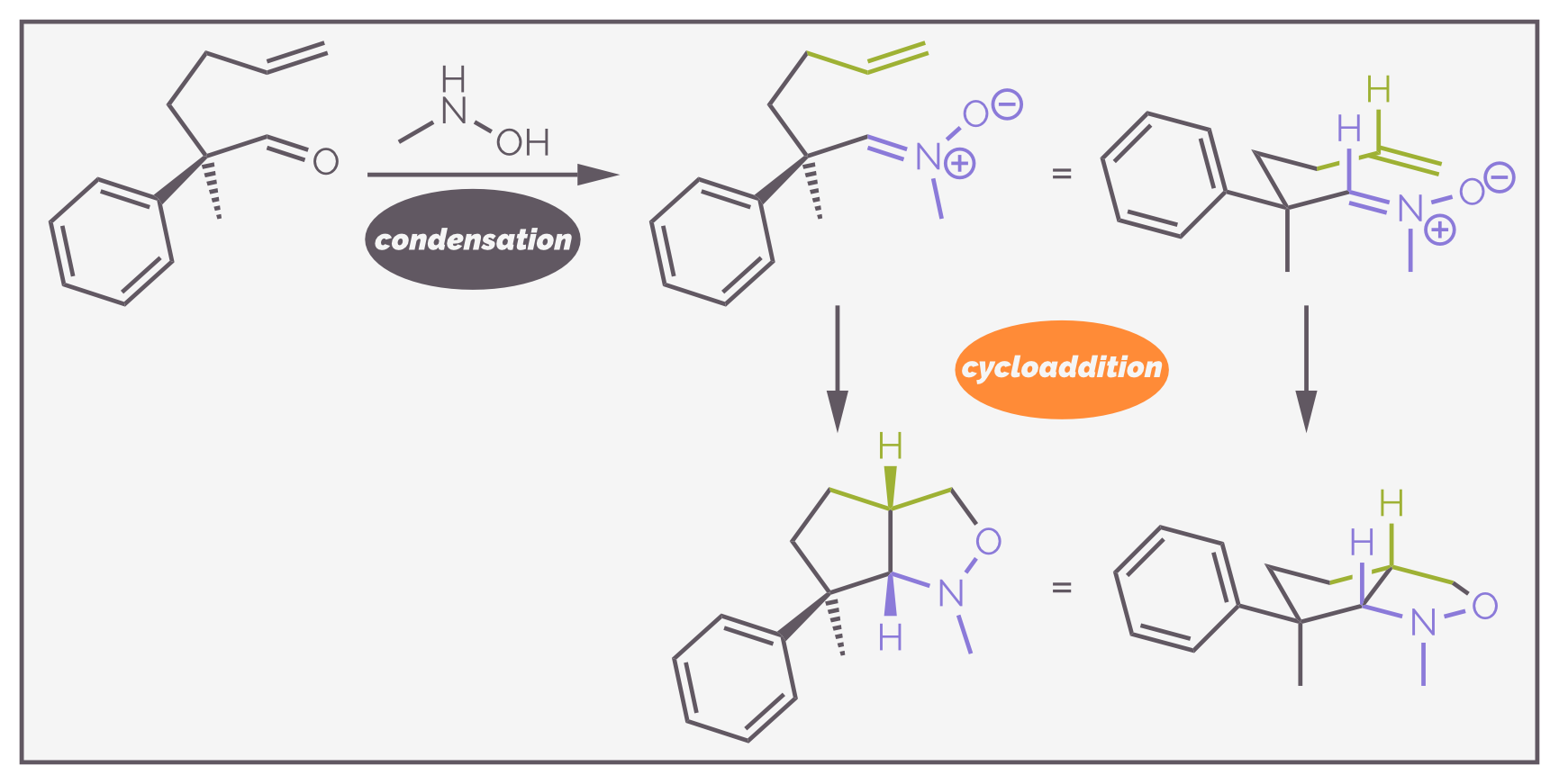
An example of the cycloaddition of a nitrone with an alkene. The nitrone is formed by the condensation of methyl hydroxylamine and an aldehyde. There are two drawings of the resulting cyclization precursor, the first is the standard skeletal representation while the second shows the forced perspective representation that suggests that the reaction proceeds through a chair-like conformation with the large phenyl group in the equatorial position. This conformation explains the relative stereochemistry.
The dipole reacts with an alkene to give an isoxazolidine. Both electron rich and electron poor alkenes make good dipolarophiles. 1,3-Dipoles are both nucleophiles and electrophiles, it is why they are called dipoles! The regioselectivity changes depending on the electronics but the mechanism does not. If the alkene is electron rich, the nitrone can be considered to be an electrophile with the LUMO accepting electrons at carbon. This puts the substituent next to the oxygen as shown below:
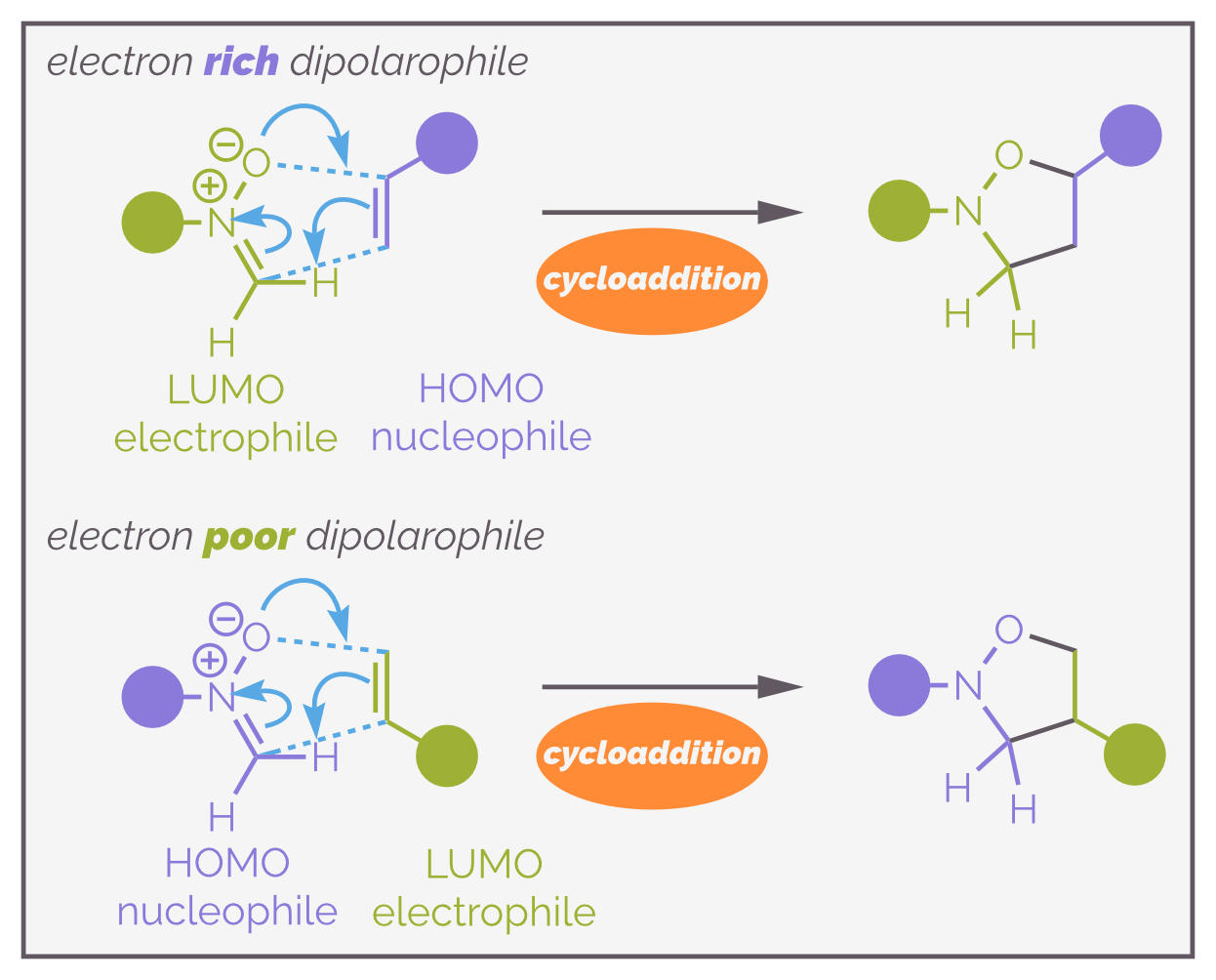
The regioselectivity of the cycloaddition can be controlled by electronics. Either component can be the electrophile or the nucleophile. With nitrones, if the dipolarophile is electron rich the nitrone will acts an electrophile. If the dipolarophile is electron poor the nitrone is the nucleophile. The mechanism is the same each time but the position of the dipolarophile substituent changes. But do note that steric bulk can change the selectivity.
The alternative has an electron deficient alkene accepting electrons from the HOMO of the nitrone. Now the substituent is opposite the oxygen. Remember, this is a cycloaddition so two σ bonds are formed in every reaction and the nitrone always acts as both nucleophile and electrophile (both its HOMO and LUMO react). In the last two paragraphs, I’m explaining the regiochemical outcome by suggesting one orbital is more important.
The stereochemistry of bent dipoles is more complex than that of linear dipoles as endo and exo isomers could exist. Unlike the Diels-Alder reaction, there are rarely secondary orbital interactions and the selectivity is entirely governed by steric interactions. This means it can be harder to predict the stereochemical outcome. The relative stereochemistry of the substituents of the dipolarophile is easy to predict. The reaction is a cycloaddition, the bonds are made and broken simultaneously. This means the geometry of the alkene is conserved in the product, it is stereospecific. The relative stereochemistry of the dipole substituents to the dipolarophile substitents is controlled by the endo/exo selectivity. It is stereoselective at best, unselective at worse.
The first example below shows the conservation of stereochemistry in the dipolarophile fragment. When a trans alkene is used the groups will be trans in the product. The reaction is stereospecific with regard to the relative stereochemistry of each component. I have also snuck into the diagram that the reaction is stereoselective with regard to the relative stereochemistry between the two reactants. Sterics favours the substituents being trans (the phenyl ketone versus the methyl ester).
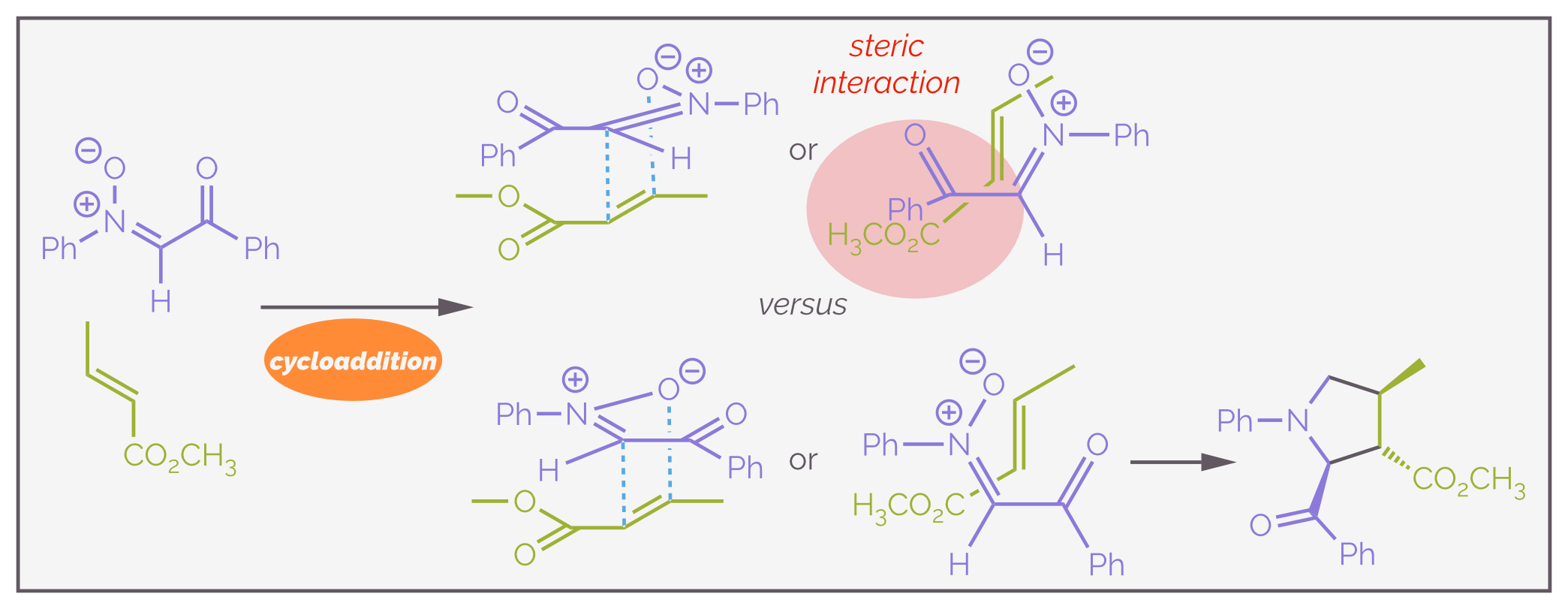
The 1,3-dipolar cycloaddition of a nitrone with a conjugated methyl ester. The stereochemistry of the dipolarophile, the alkene, is trans in the starting material and this is conserved in the product. The relative stereochemistry of the ester and ketone substituents is controlled by the minimization of steric bulk.
The second example shows the large silyl ether, or protected alcohol, influences the approach of dipolarophile. It controls which face of the lactone is attacked and that the exo transition state is favored as this avoids the interaction of the benzyl group with the lactone. It also shows the regiochemical outcome can be predicted by considering the polarity of the bonds involved.
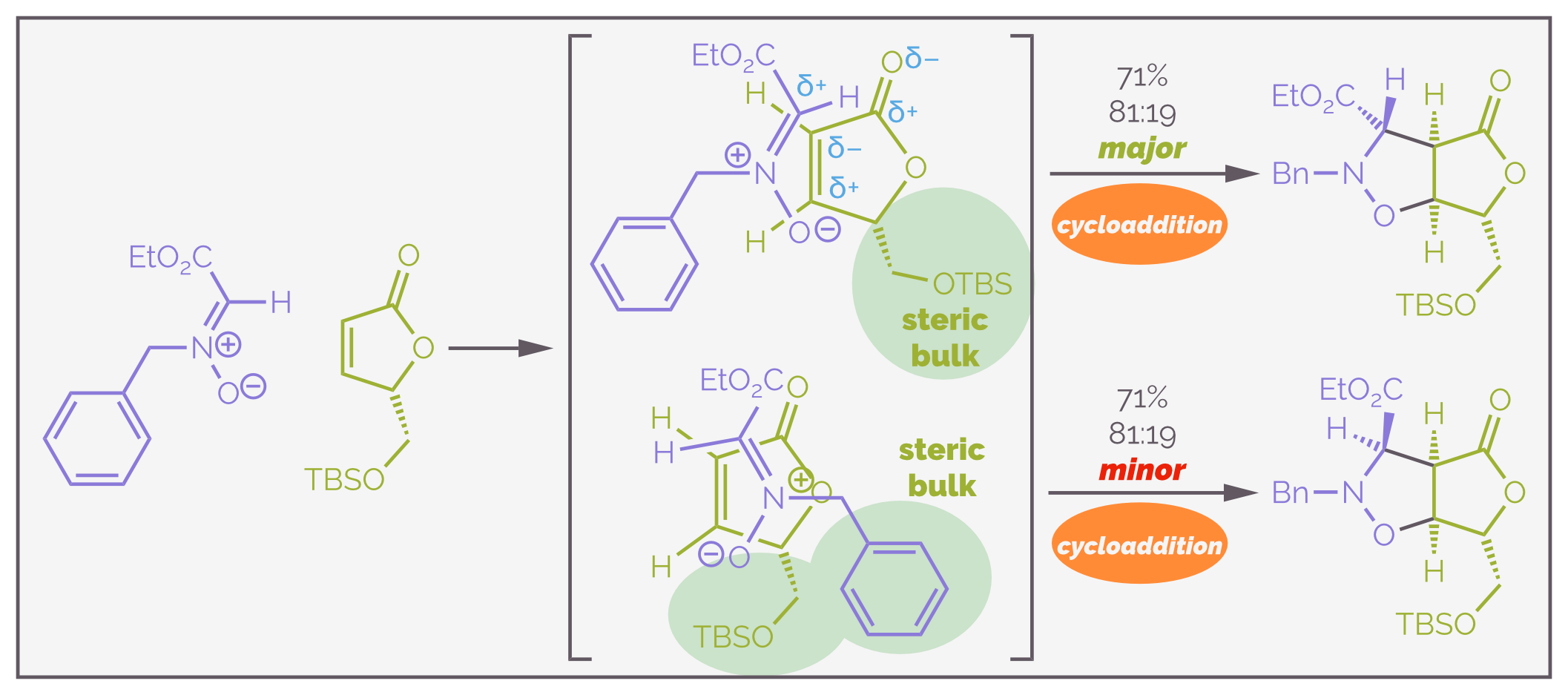
Another example of a nitrone cycloaddition. The regioselectivity is explained by the polarity of the bonds reacting. The stereochemistry is explained by steric interactions. The 1,3-dipole approaches the alkene from the opposite face to the bulky protected alcohol. The exo transition state (top) is preferred as this minimizes interactions between the benzyl group on the nitrogen and the lactone.
The simplicity of preparing nitrones and the ease of functionalizing the weak N–O bond makes nitrone cycloadditions an attractive methodology in synthesis. The first example simply shows how quickly you can build a cyclic system through the condensation of an alkyl hydroxylamine and a cycloaddition.
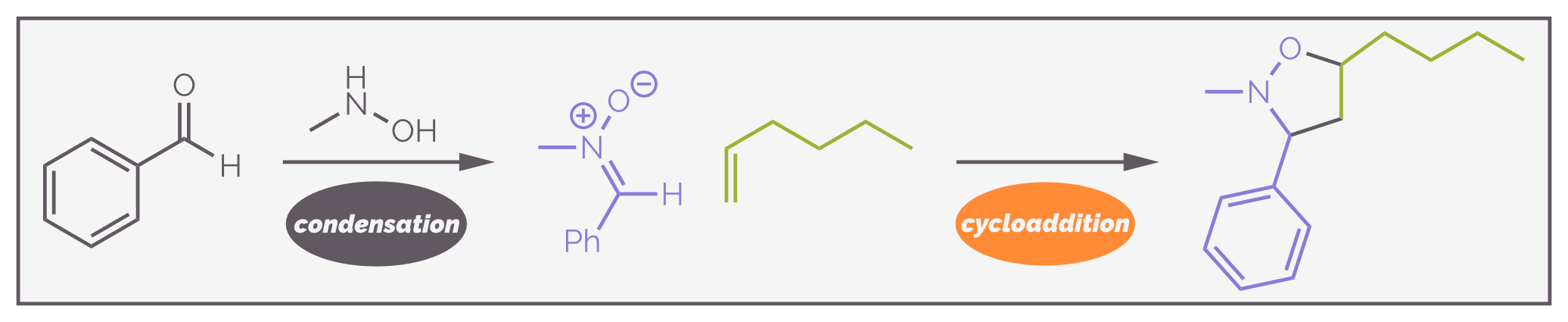
Simple example of a nitrone cycloaddition showing the condensation of benzaldehyde with methylhydroxylamine to give the 1,3-dipole. Reaction with an alkene leads to an isoxazoline in 91% yield.
The second example uses the cycloaddition to control stereochemistry ensuring that the relative stereochemistry of cocaine is set-up in a single step. The reaction begins with a [3+2] cycloreversion that unmasks the nitrone. The methyl acrylate (methyl prop-2-enoate) has a low boiling point and is driven off, leaving only the intramolecular cycloaddition as a viable reaction that creates the bicyclic structure at the heart of this natural product.
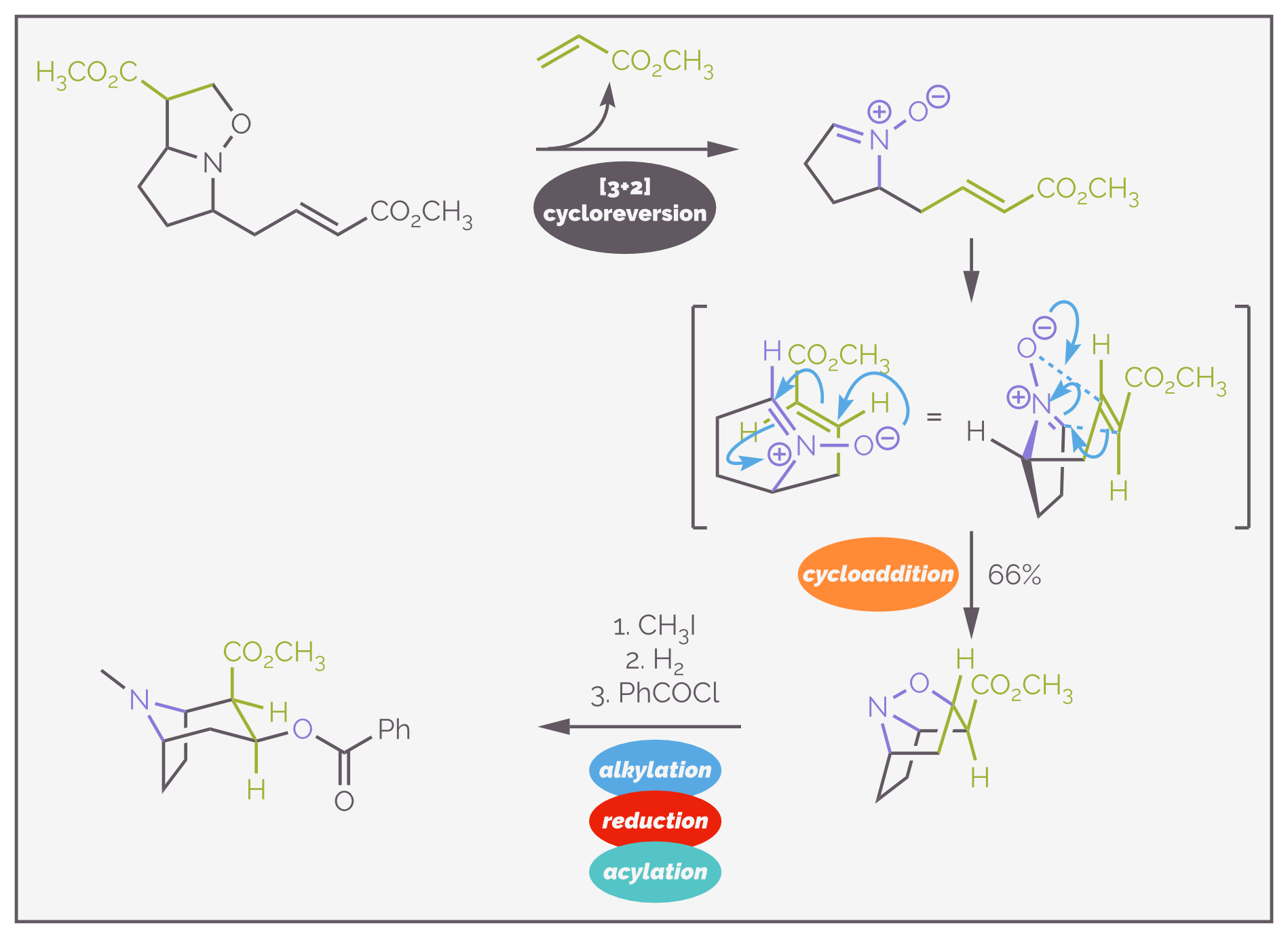
An example of an intramolecular nitrone cycloaddition taken from the synthesis of cocaine. The initial bicyclic compound undergoes a cycloreversion akin to a retro-Diels-Alder reaction to unmask the reactive nitrone. An intramolecule cycloaddition controls the relative stereochemistry of the C–O bond and the ester. Alkylation of the amine, followed by hydrogenation of the weak N–O bond, and a final acylation/ester formation gives cocaine.
Cycloadditions of Azomethine Ylides
The last cycloaddition in this brief overview is my favorite as I have a soft spot for pyrrolidines. Azomethine ylides are an example of a bent dipole and they react with alkenes to give five-membered saturated nitrogen hetereocycles known as pyrrolidines. An example is below:
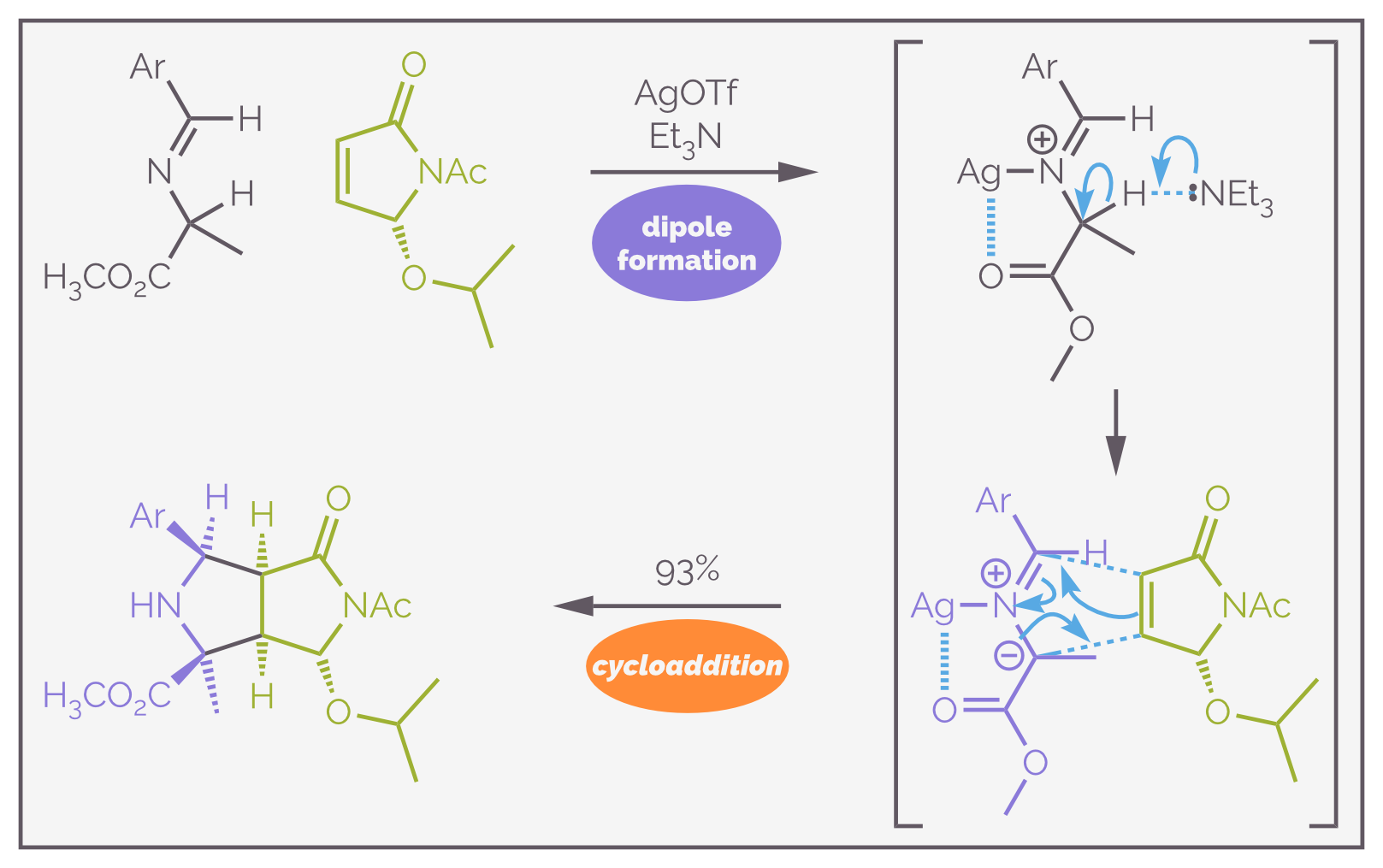
An example of an azomethine 1,3-dipolar cycloaddition. The imine starting material is not a 1,3-dipole and the azomethine ylide is only formed when the solver coordinates to the nitrogen and the α-hydrogen is deprotonated. The reaction is then the same as all the others discussed in this summary. The stereoselectivity is a result of the azomething ylide approaching from the less hindered side of the dipolarophile, opposite the bulky isopropyl ether, and must proceed through an endo-like transition state.
The starting material in this example is not the dipole, it is a simple imine. The dipole is an intermediate formed by the complexation of the nitrogen with the silver salt followed by deprotonation of the ester. The resulting ylide is a 1,3-dipole. Cycloaddition then occurs from the face opposite the bulky isopropyl group.
Not unsurprisingly, the cycloaddition of azomethine ylides is very similar to that of nitrones. This whole summary is about variations on a single reaction after all. As with nitrones, the regioselectivity can be predict by inspecting the polarity of the bonds and matching the partial charges. Hopefully, by now you can see that the the azomethine ylide is the 1,3-dipole, with four π electrons and the alkene is the two π electron component. The concerted nature of [4+2] cycloadditions means the reaction is stereospecific with regards to the geometry of both the 1,3-dipole and the alkene.
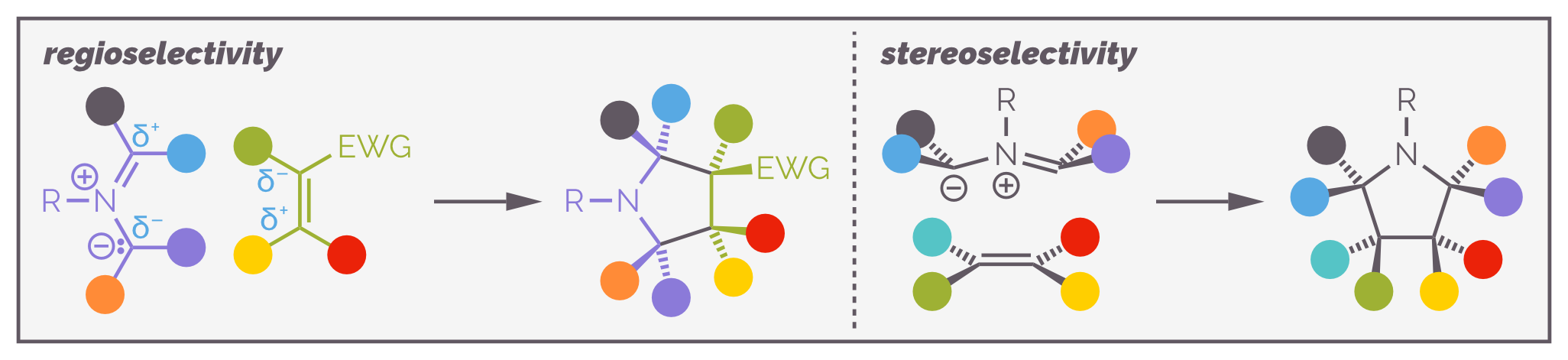
The regioselectivity of the azomethine 1,3-dipolar cycloaddition can be predicted by the polarization of the bonds in most examples. As the reaction is a cycloaddition, the stereochemistry of the precursors is conserved in the product.
There are a number of methods to create azomethine ylides. The most common involves imine formation followed by coordination to a metal, frequently silver, in the presence of a base. The silver salt coordinates to the nitrogen to give a cationic iminium ion. This increases the acidity of the α-proton facilitating deprotonation even by a weak base. Often, there is an ester adjacent to the imine and the metal will coordinate both the imine and the carbonyl group. This fixes the geometry of the ylide and eases the deprotonation yet further.
In the example below, the 1,3-dipole approaches the alkene in an endo-like transition state, probably due to an interaction between the metal salt and the ketone (proximity hinted at in the transition state below). Alternatively, steric hindrance, with the dipole avoiding the acetal, might cause the selectivity. The stereocenter of the acetal controls the approach of the dipole to the alkene. The conformation of the alkene alkene is drawn to agree with Houk's ‘inside alkoxy’ model. The favored conformation has the bulky electron donating alkyl groups anti to the incoming dipole, with the oxygen almost parallel to the alkene. This avoids a deactivating interaction between the C–O σ* antibonding orbital and the alkene.
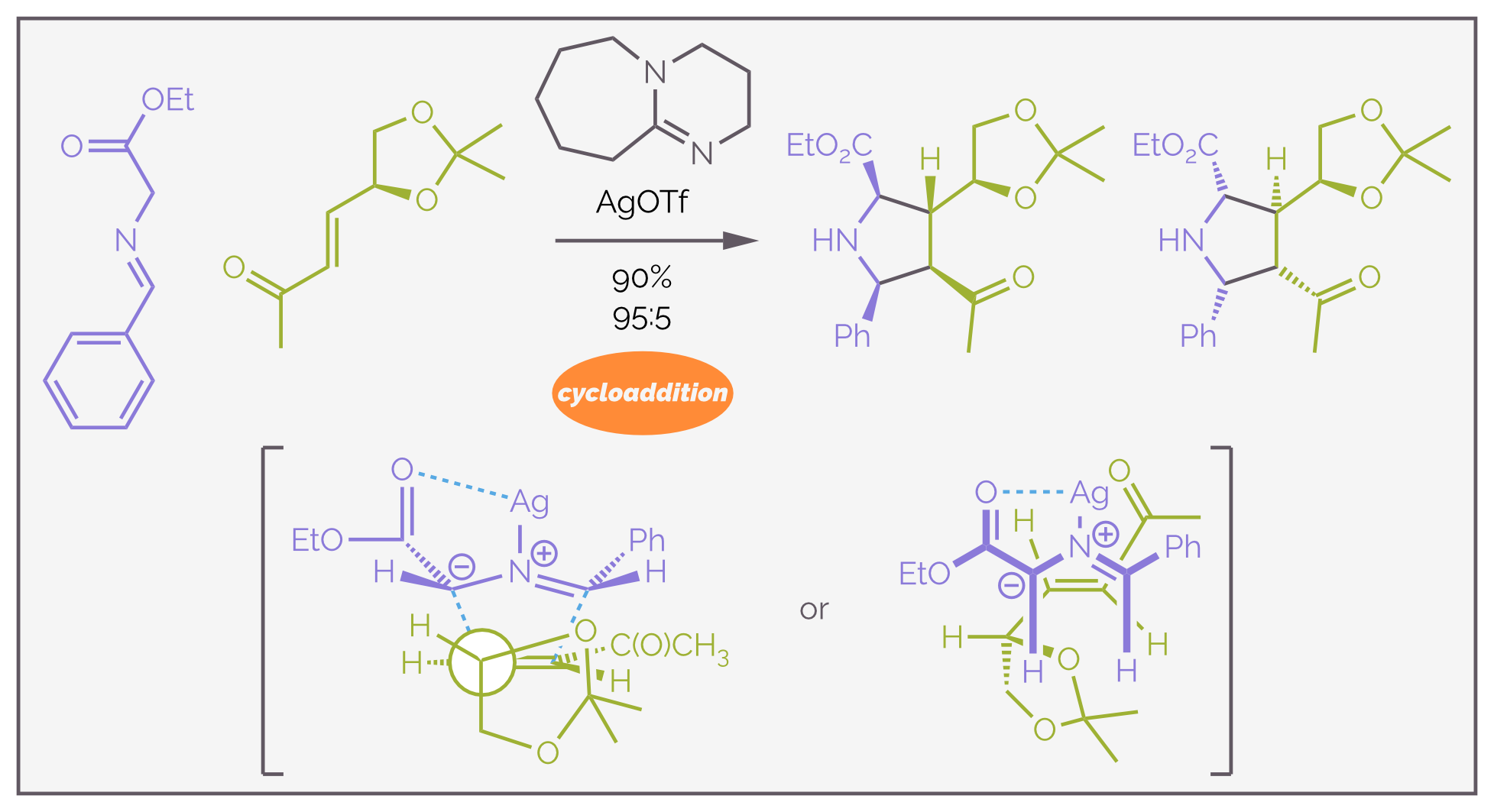
An example of an azomethine 1,3-dipolar cycloaddition. The dipole is formed by the imine interacting with the silver salt and then DBU deprotonating the α-proton. Arguably, the transition state could be drawn as an enolate. Applying Houk’s inside alkoxy model, the acetal stereocentre blocks the bottom face as shown on the left hand side. The azomethine ylide approaches in the endo transition state possibly due to the ketone and silver coordinating, as hinted by the right hand transition state or it could just be a steric argument.
An alternative, but less common, method to form an azomethine ylide is the condensation of a secondary amine with an aldehyde as demonstrated below. This simple approach prevents the use of catalysts (although I wonder if there are examples using chiral phosphoric acids as an asymmetric counterion?).
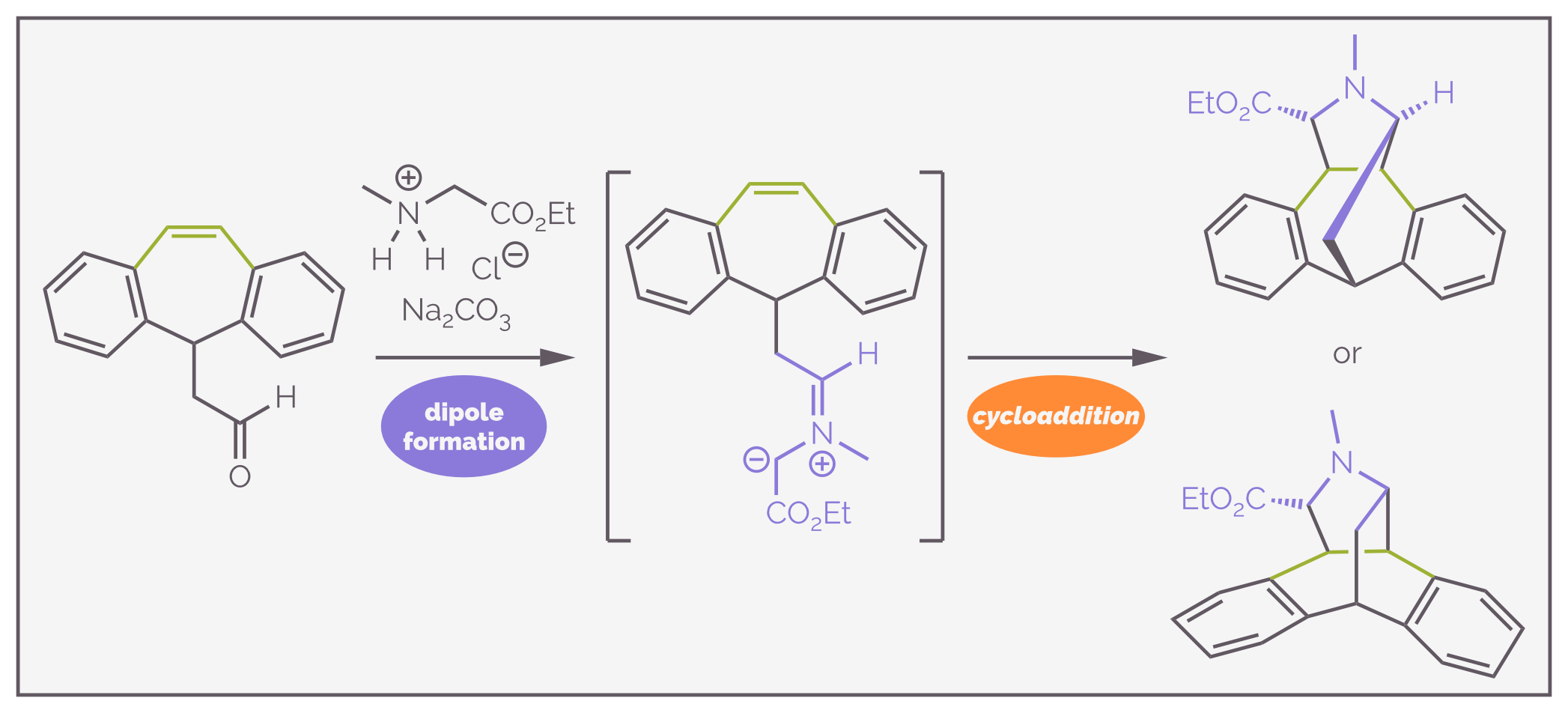
An example of an intramolecule azomethine ylide 1,3-dipolar cycloaddition. The ylide is formed by the condensation of a secondary amine with an aldehyde in the presence of a base. The resulting iminium ion is deprotonated to form the ylide. Cycloaddition is probably promoted by the strained alkene.
Conclusions
Cycloadditions provide a rapid and controlled method for the construction of ring systems. In this summary, I’ve introduced 1,3-dipolar cycloadditions for the construction of five-membered heterocycles. Electronically, these reactions involve 4+2 π electrons and are analogous to Diels-Alder reactions. As they are concerted reactions, the geometry of the dipole and the dipolarophile are preserved in the stereochemistry of the final product, the reactions are stereospecific in this regard. Unlike Diels-Alder reactions both the regioselectivity and stereoselectivity can be less predictable and is mainly controlled by steric considerations with electronic factors having less influence.
There are many different kinds of 1,3-dipolar cycloaddition, differing by both the dipole and the dipolarophile. The four covered above give a general overview. Common examples that haven’t been mentioned are the cycloadditions of diazo alkanes, ozone, carbonyl ylides and some metal-oxo species. While not comprehensive, I hope this introduction has shown the value of 1,3-dipolar cycloadditions.
As with the introduction to the Diels-Alder reaction, I have avoided discussion of orbitals and symmetry. I have also missed the two biggest examples of 1,3-dipolar cycloadditions, ozonolysis and dihydroxylation. These reactions start with a cycloaddition but then continue to along more complex mechanisms and deserve their own summaries.